For a complete diagnosis of this issue, see our guide to The Wasted Ad Spend Diagnosis Framework — the 6-step diagnosis framework for identifying waste.
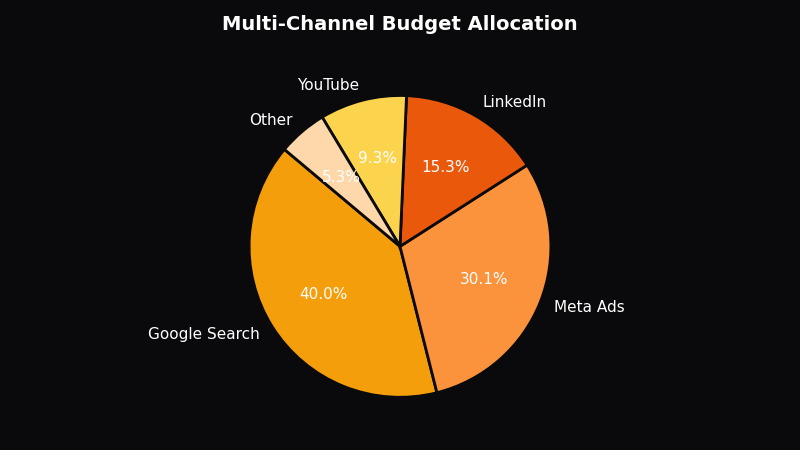
Your ad spend is too high for your small business if your monthly advertising cost exceeds 12% of gross revenue, or if your cost-per-lead is more than 30% above the industry benchmark for your category. Use the benchmarks below — organized by monthly spend level and industry — to identify whether your budget is misaligned with what businesses at your revenue level typically spend profitably.
Small businesses are uniquely vulnerable to ad spend misalignment. Unlike enterprises with dedicated media teams and established benchmarks, SMBs often set budgets by feel — a $5,000/month Google Ads spend might sound reasonable for a business generating $50,000/month, but it could be completely wrong for a local service operation with thin margins and an average ticket size of $200. The benchmarks below give you a data-grounded reference point.
—
## How to Read These Benchmarks (And Why Most Free Tools Get It Wrong)
Most free benchmarking tools give you a single number: “small businesses should spend 7–10% of revenue on marketing.” This is too blunt. The right benchmark depends on three variables:
[Case Study: B2B SaaS, $90K Monthly Program] A B2B SaaS company spending $90K/month on LinkedIn and Google Ads used last-click attribution, which heavily credited LinkedIn’s bottom-funnel content. Bayesian MMM identified LinkedIn’s role as primarily awareness — it was influencing Google searches that last-click then credited to Google. After separating the channels by funnel stage and reallocating 25% of LinkedIn budget to upper-funnel Google targeting, demo requests increased 28% while cost-per-demo dropped from $340 to $218. The model showed LinkedIn’s actual contribution was 2.4× what last-click reported.
1. **Monthly ad spend level** — efficiency curves change at $1K, $5K, and $10K+ per month
2. **Business type** — e-commerce, local services, B2B, and SaaS have fundamentally different unit economics
3. **Revenue concentration** — if 80% of your revenue comes from paid ads, your benchmarks are different than if 30% does
The benchmarks below are organized by spend level first, then by industry, so you can find your specific situation.
—
## Benchmarks by Monthly Budget Level
### $1,000/month Ad Spend Benchmarks
At $1,000/month in paid media, your primary channel should be high-intent Google Search. You don’t have enough budget to run broad awareness campaigns effectively. The target ROAS for this spend level is typically 3x–5x, meaning your monthly revenue attributable to ads should be $3,000–$5,000. If you’re running Meta Ads at this budget, focus on retargeting warm audiences — cold Meta campaigns at $1K/month don’t accumulate enough data to optimize.
Cost-per-lead benchmarks at $1K/month:
– Home services / local: $25–$50 CPL
– E-commerce: $15–$30 CPC with 3–5% conversion rate
– B2B lead gen: $75–$150 CPL
– Professional services: $50–$100 CPL
### $2,500/month Ad Spend Benchmarks
At $2,500/month, you have enough budget to run one primary channel efficiently plus a small retargeting layer. Google Ads should represent 60–70% of spend (high intent, direct response), Meta 20–30% (warm retargeting and lookalike prospecting). Target ROAS: 2.5x–4x.
This spend level is where most SMBs make their biggest mistake: splitting budget evenly between Google and Meta without a clear attribution story for why each channel is earning its share. The result is two mediocre campaigns instead of one excellent one.
### $5,000/month Ad Spend Benchmarks
At $5,000/month, you can run 2–3 active campaigns across channels. The split should be: 50% Google Search (direct intent), 30% Meta (warm prospecting + retargeting), 20% YouTube or programmatic (awareness). Target ROAS: 2x–3.5x depending on industry.
At this level, a single inefficient campaign can waste $1,000–$2,000/month. Implement monthly ROAS reviews by campaign and reallocate budget away from anything below your break-even ROAS threshold.
### $10,000/month Ad Spend Benchmarks
At $10,000+/month, you have the budget for multi-channel orchestration — but also the highest risk of structural waste. Benchmark targets:
– E-commerce: 2.5x–4x ROAS
– Local services: $30–$75 CPL
– B2B/SaaS: $100–$250 CPL with 5–10% close rate
– Subscription/recurring revenue: target CAC payback under 6 months
—
## Benchmarks by Industry
According to Deloitte’s 2025 SMB marketing benchmarks, advertising spend as a percentage of revenue varies dramatically by sector — from 6–8% in professional services to 15–20% in e-commerce — because each sector’s average margin and customer lifetime value create different break-even economics for paid media.
### Home Services / Local
Healthy range: 4–8% of gross revenue toward advertising. Target CPL: $30–$60. Google Local Services Ads should be the primary channel — they carry higher intent and lower CPC than traditional Search for local service keywords. Meta is secondary, used for neighborhood-level targeting and retargeting.
### E-commerce / Retail
Healthy range: 10–20% of gross revenue toward advertising. Target ROAS: 3x–5x. This is the highest-spend category relative to revenue because e-commerce margins are typically 30–60% and competition for high-intent product searches is intense. Most e-commerce waste comes from Shopping campaigns running without margin-adjusted ROAS targets.
### B2B / Lead Gen
Healthy range: 2–6% of projected annual revenue toward demand generation. Target CPL: $75–$200 depending on deal size. B2B waste is usually in the form of top-of-funnel campaigns generating unqualified leads — LinkedIn campaigns with low conversion rates, or Google Ads running on keywords that attract researchers rather than buyers.
### Healthcare / Professional Services
Healthy range: 3–7% of gross revenue. Target CPL: $50–$120. Healthcare and legal verticals have the highest CPCs in Google Ads (often $20–$80 per click) because the conversion value is high. The risk at this spend level is burning through budget on clicks with no appointment booking — usually caused by landing pages that require too much commitment before delivering value.
### SaaS / Tech
Healthy range: 5–15% of revenue toward demand gen. Target CAC payback: under 6 months. SaaS waste usually manifests as spending on trial sign-ups that never convert to paid — the conversion event is misaligned to the sales cycle length. Fix it by tracking qualified demo requests, not just sign-ups.
—
## How Your Numbers Stack Up — Red Flags vs. Normal Variance
A few points above or below the benchmarks is normal variance. A 40%+ deviation in either direction is a red flag:
| Signal | What It Means | Action |
|——–|—————|——–|
| CPL 40%+ above benchmark | Targeting too broad or ads not resonant | Tighten audience, refresh creative |
| ROAS 40%+ below break-even | Channel-to-offer mismatch or unit economics don’t support ads | Reconsider channel or product pricing |
| Spend/revenue ratio above 20% | Budget set without revenue reference | Re-anchor to percentage-of-revenue method |
| CPC 40%+ above industry | Quality Score problems or keyword competition | Audit landing pages and match types |
—
## What to Do If You’re Above Benchmark
If your numbers are consistently above these benchmarks, you have three levers: reduce spend (cut the worst campaigns first), improve efficiency (fix the targeting/creative/landing pages), or change the channel mix (shift budget to higher-performing channels). Don’t try all three simultaneously — fix the structural problems first (broken conversion tracking, wrong conversion event), then adjust spend.
Use the marketing waste calculator to get a precise waste percentage for your specific numbers.
—
Frequently Asked Questions
Q: Is my ad spend too high for my small business?
A: Calculate your ad spend as a percentage of gross revenue. If it exceeds 12%, you are likely overspending relative to what your advertising profitably returns. More specifically, compare your cost-per-lead or cost-per-conversion to the benchmarks above for your industry and spend level. If your CPL is 40%+ above the benchmark for your category, your budget may be right but your efficiency is the problem — look at why is my ad spend so high for the root cause diagnosis.
Q: How much should a small business spend on Google Ads per month?
A: For most small businesses, a reasonable starting point is 5–10% of gross monthly revenue allocated to Google Ads. A business generating $50,000/month in revenue should start at $2,500–$5,000/month in Google Ads — enough to accumulate meaningful optimization data while remaining within efficient ROAS targets. Adjust based on your specific CPL or ROAS benchmarks against the industry numbers above.
Q: What should I spend on ads by industry?
A: Industry benchmarks vary significantly: home services businesses typically spend 4–8% of revenue, e-commerce 10–20%, B2B services 2–6%, and healthcare/professional services 3–7%. The right number for your business also depends on your average ticket size and gross margins — a $500 service with 60% margins can sustain higher ad spend than a $50 product with 30% margins. Use the marketing waste calculator to determine your specific waste percentage.
Further Reading & Sources
- Nielsen — global measurement and analytics
- McKinsey & Company — global management consulting
- American Marketing Association — marketing association
- Forrester Research — research and advisory
- Meta for Business — business advertising on Meta
Owner’s Note
The practical question is which dollars you would least miss if they disappeared next month. Before changing the budget, compare the article’s framework with your own last 30 to 90 days of spend, revenue, and qualified outcomes. The best next move should be small enough to test, clear enough to measure, and tied to profit rather than platform-reported activity.
Leave a Reply