
If you’re spending money on Facebook ads and wondering whether it’s working, you’re not imagining things. According to a 2024 Meta transparency report, CPMs on the platform have risen over 40% since Apple’s iOS 14.5 privacy changes, while average click-through rates have declined. The result: many small business owners are paying more and getting less. Here are five signs your budget is burning — and what to do if you spot them.
Sign 1: High CPM With Low CTR
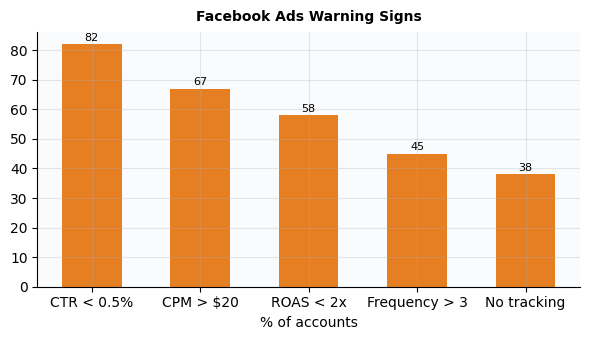
Your cost per thousand impressions (CPM) tells you how much Facebook charges to show your ad. Your click-through rate (CTR) tells you whether people care. When CPM is high (above $15) and CTR is low (below 0.5%), you’re paying top dollar for ad space that nobody is engaging with. This combination usually means your audience targeting is too broad or your creative isn’t compelling enough to stop the scroll.
Fix: Narrow your audience by layering interests and behaviors. Test new creative with a different hook. Facebook’s algorithm optimizes for engagement, so if nobody engages, it keeps showing your ad to people who won’t engage — a vicious cycle that burns budget fast.
Sign 2: Declining Relevance Score (or Quality Ranking)
Facebook’s relevance score (now called Quality Ranking) measures how relevant your ad is to your audience on a scale of 1-10. If your score drops below 5, Facebook charges you more per impression because your ad is less likely to get engagement. According to Facebook’s own documentation, ads with high relevance scores can pay up to 50% less per click than ads with low scores.
Fix: Refresh your creative, tighten your targeting, or split your ad set into smaller, more focused groups. A single ad that tries to appeal to “everyone interested in business” will have a low relevance score for everyone. One ad for “restaurant owners in Chicago” will score much higher with that audience.
Sign 3: Frequency Above 4 With No Improvement
Frequency is how many times the average person has seen your ad. When frequency exceeds 4, CTR typically drops by 50% or more because your audience has already seen the ad and decided not to act. Yet many small business owners let frequency climb to 6, 8, or even 10 because they don’t understand the metric.
Fix: Set frequency caps in your ad set settings (limit to 1-2 impressions per person per week). If frequency is already high, create a new ad set with fresh creative and a broader audience. You can also exclude people who’ve already clicked or converted using Facebook’s custom audiences.
Sign 4: Clicks But No Conversions for More Than 2 Weeks
Clicks cost money. If people are clicking but nobody is buying or signing up, something between the click and the conversion is broken. This could be a landing page issue, a form that’s too long, a pricing page that confuses people, or mobile responsiveness problems — Facebook’s traffic is predominantly mobile.
Fix: Audit your conversion path. Open your ad, click through, and try to complete the purchase or signup yourself. Time how long it takes. Check page load speed on mobile. Ensure your tracking pixel is correctly installed and that your conversion event is properly defined. Sometimes the ad is fine and the landing page is the real problem.
Sign 5: The Same Audience With the Same Creative for 60+ Days
Ad creative has a shelf life. According to Meta’s own best practices, ad creative refreshes every 2-4 weeks are recommended for optimal performance. Running the same ad to the same audience for two months means ad fatigue is almost certain — and you’re paying full price for declining results.
Fix: Build a creative rotation schedule. Swap images, headlines, offers, and calls-to-action every 2-3 weeks. Use Facebook’s dynamic creative feature to automatically test different combinations. If you find a winner, duplicate it with minor variations rather than running it into the ground.
Frequently Asked Questions
How can I tell if my Facebook ads are profitable?
Calculate your return on ad spend (ROAS) by dividing revenue generated by ad spend. A ROAS of 3x means you earn $3 for every $1 spent. But remember to factor in your product margins — a 3x ROAS on a 20% margin product is less profitable than a 2x ROAS on a 50% margin product.
What is a good CTR for Facebook ads?
Average Facebook ad CTR across all industries is 0.9% for link clicks. Above 1.5% is strong. Below 0.5% needs attention. However, CTR varies by industry and ad format — video ads typically have different benchmarks than image ads.
How to reduce wasted Facebook ad spend?
Start by pausing your worst-performing campaigns and reallocating budget to your top 1-2 campaigns. Then work through the diagnostic steps above. For a more systematic approach, consider a Bayesian MMM tool like OptiMix that analyzes your full channel mix and identifies waste without relying on individual user tracking.
What is Facebook ad relevance score?
It’s Facebook’s 1-10 rating of how relevant your ad is to your target audience. Higher scores mean lower costs per click. The score is based on positive feedback (clicks, conversions) and negative feedback (hiding the ad) that Facebook predicts your ad will receive.
How to optimize Facebook ads for conversions?
Choose the “Conversions” campaign objective. Set up the Facebook pixel or Conversions API to track purchases. Start with a small budget, let the algorithm learn (allow 50+ conversion events), then scale winners. Use lookalike audiences from your customer list for best results.
Owner’s Note
The practical question is whether Meta spend is producing qualified demand or just cheap activity. Before changing the budget, compare the article’s framework with your own last 30 to 90 days of spend, revenue, and qualified outcomes. The best next move should be small enough to test, clear enough to measure, and tied to profit rather than platform-reported activity.
Leave a Reply