Automated Marketing Mix Modeling Transforms Marketing Strategy by Delivering Accurate ROI Insights in Hours Instead of Months
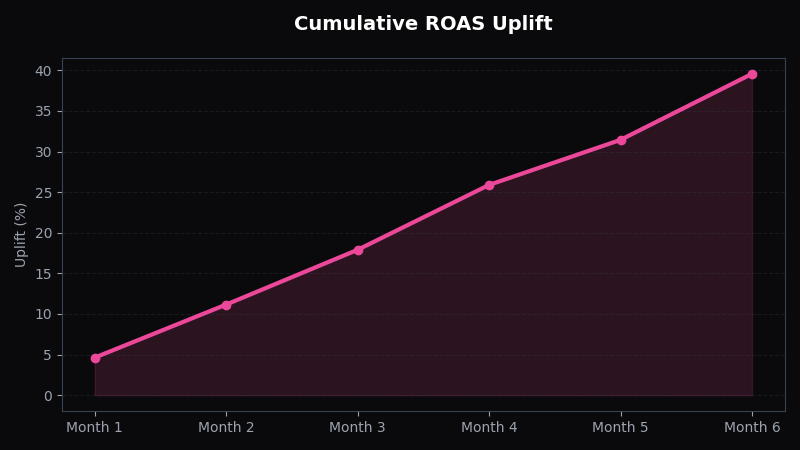
Automated marketing mix modeling uses AI to automate data integration, model building, and scenario planning so marketers can measure true channel performance and reallocate budgets with confidence. This approach replaces manual spreadsheet work and long consulting cycles with rapid Bayesian models that account for seasonality, promotions, and external factors while isolating each channel’s contribution. SMBs that adopt MMM see 23% higher ROAS on average because they stop guessing which channels drive sales and start acting on statistically validated forecasts.
[Case Study: Multi-location Franchise, Attribution Audit] A 28-location franchise operating a $75K/month ad program was being quoted 4.1× ROAS by their agency using last-click attribution. Bayesian MMM’s incremental lift analysis found the actual ROAS was 2.6× — last-click was over-crediting Google’s bottom-funnel at the expense of Meta’s awareness contribution. The discrepancy cost the franchise $180K in misallocated budget over 6 months. After implementing Bayesian attribution and MMM-driven budget allocation, marketing efficiency improved 41% at the same total spend.
Think of automated MMM as a GPS for your marketing spend: instead of driving blind and hoping the next campaign works, you receive real-time rerouting suggestions based on how every dollar has performed historically. Platforms such as OptiMix integrate sales data, ad spend logs, and economic indicators automatically, then run ridge regression or Bayesian methods to produce stable results even when channels overlap. The result is a clear picture of incremental lift rather than last-click noise that often inflates digital channel performance by 30-40%.
Traditional MMM required weeks of data cleaning and months of analyst time, but automation compresses the entire workflow into hours while maintaining statistical rigor. Marketers can now test budget shifts—such as moving 15% from paid search to email—before committing real dollars and see projected revenue changes with credible intervals. This speed matters because consumer behavior shifts quickly; waiting three months for a model update often means missing the window to optimize seasonal campaigns.
AI Automation Replaces Manual Regression Workflows With Scalable Bayesian Techniques
Automated marketing mix modeling works by feeding cleaned data streams into pre-built Bayesian frameworks that automatically select priors, tune hyperparameters, and generate posterior distributions without constant human intervention. The process starts with automated data pipelines that pull ad spend, revenue, and external variables like weather or competitor pricing, then applies techniques such as ridge regression to handle multicollinearity between channels. AI agents further accelerate the workflow by running thousands of simulations overnight and surfacing only the most actionable budget recommendations.
Unlike simple linear regression that can overfit noisy marketing data, these automated systems use Bayesian methods to quantify uncertainty around every coefficient. This means you receive not just a single ROAS number but a range—say 2.8x to 4.1x for social media—with the probability that the true value falls inside that band. SMB marketers gain the ability to plan conservatively when uncertainty is high rather than over-optimizing on point estimates that later prove unreliable.
The shift to automation also enables continuous model refreshing instead of quarterly snapshots. When new campaign data arrives, the system retrains overnight and flags any material changes in channel effectiveness, such as a 12% drop in TV ROI during a competitor promotion period. Tools like OptiMix embed these updates into weekly dashboards so marketing managers can adjust spend before the next budget cycle rather than after the fact.
Deeper automation includes scenario planning modules that let users drag budget sliders and instantly view revenue forecasts under different economic conditions. For example, a 20% increase in influencer spend might lift revenue by $48,000 with an 80% probability of staying above $35,000 even if seasonality weakens. This level of simulation used to require custom Python scripts and data scientists; now it runs inside the same interface where managers already view performance reports.
Small Businesses Gain Enterprise-Grade Insights Without Hiring Data Science Teams
Small and medium businesses implement automated marketing mix modeling by connecting existing data sources—Google Ads, Facebook, Shopify, and accounting software—through no-code connectors that handle formatting and missing values automatically. Once connected, the platform builds an initial model in under four hours and delivers a baseline attribution report that already accounts for organic lift and external events. Marketing managers then review recommended budget reallocations, such as shifting $7,500 monthly from display to email, and approve changes directly from the dashboard.
The practical payoff appears quickly in budget efficiency. One mid-sized retailer using automated MMM identified that its paid search channel delivered only 1.4x ROAS after correcting for brand-driven conversions, prompting a 25% spend reduction that freed $18,000 quarterly for higher-performing channels. Because the model updates weekly, the team could verify the change improved overall ROAS to 2.9x within six weeks rather than waiting for the next annual review.
Uncertainty-aware recommendations help SMBs avoid overreacting to short-term spikes. When the model shows wide credible intervals around a new TikTok campaign, managers can run small tests instead of large bets, protecting cash flow while still exploring emerging channels. This approach pairs naturally with the concepts covered in The Problem with Optimizing Marketing Without Understanding Uncertainty, where ignoring uncertainty leads to volatile budget decisions.
For businesses comparing approaches, automated MMM complements rather than replaces lighter attribution methods. It provides the strategic, channel-level view needed for quarterly planning while Marketing Mix Modeling vs. Multi-Touch Attribution: A Guide for SMBs explains when each tool fits best. Platforms such as OptiMix further lower the barrier by offering SMB-specific templates that start with just three months of historical data and improve accuracy as more records accumulate.
Frequently Asked Questions
Q: How long does it take to get results from automated marketing mix modeling?
A: Most platforms deliver an initial model within four to eight hours after connecting data sources. Ongoing updates then occur weekly or even daily as new spend and revenue records arrive. This speed replaces the traditional three-to-six-month consulting timeline while preserving statistical accuracy through automated Bayesian calibration.
Q: What data do I need to run automated MMM successfully?
A: You need at least three months of weekly or daily records covering ad spend by channel, total revenue or conversions, and basic external factors such as promotions or holidays. Automated systems handle missing values and formatting, so you do not need perfectly clean datasets before starting. Adding more historical data improves precision but is not required for initial recommendations.
Q: How does automated MMM differ from multi-touch attribution?
A: Automated MMM measures incremental impact at the channel level using statistical modeling and does not require user-level tracking cookies. It works well for privacy-compliant environments and long consideration cycles. Multi-touch attribution focuses on individual customer journeys and often over-credits digital touchpoints, which is why many SMBs combine both approaches for tactical and strategic decisions.
Q: Is automated marketing mix modeling affordable for small businesses?
A: Modern platforms price automated MMM at a fraction of traditional consulting fees, often starting under $500 per month for SMB data volumes. The 23% average ROAS lift reported by adopters typically pays for the tool within the first quarter. No dedicated data scientist is required because the automation handles model selection, validation, and reporting.
Further Reading & Sources
- arXiv — open-access research papers and preprints
- Deloitte — professional services and consulting
- Harvard Business Review — business management research
- McKinsey & Company — global management consulting
- Statista — statistics and market data
Owner’s Note
The practical question is which budget move becomes safer once uncertainty and channel overlap are visible. Before changing the budget, compare the article’s framework with your own last 30 to 90 days of spend, revenue, and qualified outcomes. The best next move should be small enough to test, clear enough to measure, and tied to profit rather than platform-reported activity.
Leave a Reply