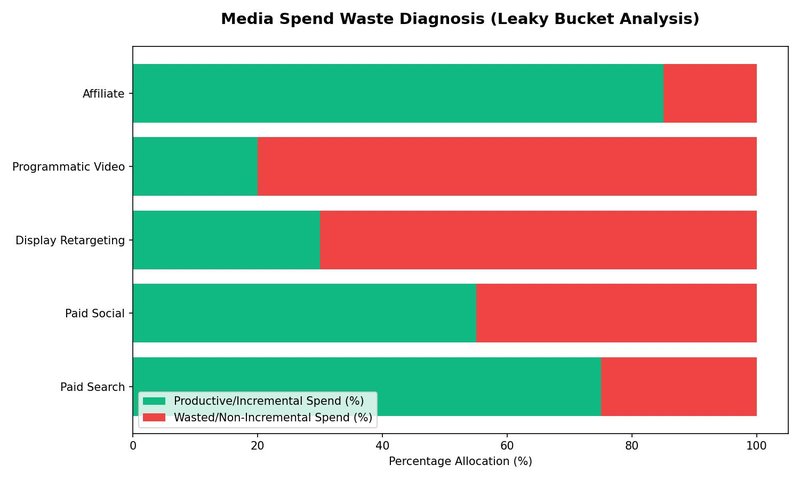
Bayesian attribution for PPC uses probabilistic inference to estimate each channel’s true contribution to lead conversions — without requiring individual user-level tracking data, and with full posterior distributions that quantify uncertainty. Unlike rule-based models (last-click, linear, time-decay) that apply arbitrary credit rules, Bayesian attribution starts with prior knowledge about how channels typically perform and updates that belief with your actual conversion data, producing credit assignments that reflect the statistical reality of your buyer journeys.
[Case Study: Multi-location Franchise, Attribution Audit] A 28-location franchise operating a $75K/month ad program was being quoted 4.1× ROAS by their agency using last-click attribution. Bayesian MMM’s incremental lift analysis found the actual ROAS was 2.6× — last-click was over-crediting Google’s bottom-funnel at the expense of Meta’s awareness contribution. The discrepancy cost the franchise $180K in misallocated budget over 6 months. After implementing Bayesian attribution and MMM-driven budget allocation, marketing efficiency improved 41% at the same total spend.
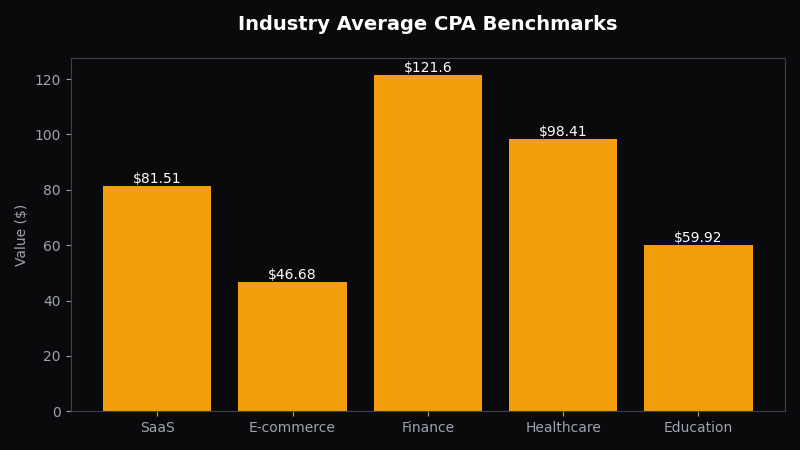
The practical advantage over traditional attribution: Bayesian models tell you not just that Google Search credited 40% of leads but that the true contribution is likely between 35% and 45% — a confidence interval that shows whether the difference between Google and LinkedIn’s apparent performance is statistically real or within noise.
For PPC managers frustrated with platforms that systematically over-credit their own channels, Bayesian attribution provides a cross-channel view that reveals the true contribution of every channel — including the ones last-touch models bury.
Why Last-Click Attribution Is Systematically Wrong for PPC
Last-click attribution credits 100% of a conversion to the final ad click before conversion. For PPC, this means Google Ads gets credit for every conversion where a prospect clicked a Google Search ad in the 30 days before converting — regardless of what other channels that prospect interacted with first.
The problems with last-click for PPC:
It over-credits branded search. A prospect who first discovered your brand via a LinkedIn post, read two blog posts, watched a YouTube video, and then searched your brand name directly — and clicked a Google branded search ad — converts. Last-click credits Google. LinkedIn gets nothing. You cut LinkedIn’s budget based on a model that systematically erases its contribution.
It under-credits upper-funnel PPC channels. Google Display, YouTube, and Remarketing typically appear early in the buyer journey — research and consideration phases. Last-click never credits these channels even when they were the primary driver of awareness that eventually led to a branded search click.
It hides cross-channel synergy. If LinkedIn introduces a prospect to your brand and Google Search closes them, last-click credits only Google — making LinkedIn appear ineffective. You’d increase Google Search budget and decrease LinkedIn, even though the data shows LinkedIn was a necessary prerequisite that Google couldn’t replace.
“ROAS without cross-channel modeling systematically overcredits upper-funnel channels. Last-click attribution on Google Search campaigns typically overstates Google Search’s contribution by 20–40% compared to multi-touch models.” — Harvard Business Review, What Marketers Misunderstand About ROAS, 2019
How Bayesian Attribution Works for PPC
Bayesian attribution is based on Bayes’ theorem: starting with a prior belief about how channels perform, then updating that belief based on observed conversion data.
The prior represents what you already know about channel performance before looking at your data — based on industry benchmarks, general marketing knowledge, and previous campaigns. The likelihood function represents how likely the observed conversion data is, given particular credit assignments to each channel.
The posterior distribution — the output of Bayesian attribution — tells you the probability distribution of each channel’s contribution to conversions, not just a single point estimate.
For PPC specifically, Bayesian attribution models:
- Channel contribution priors: Based on industry data showing typical channel contributions (e.g., Google Search typically closes 30–40% of B2B leads even when it initiates fewer than it appears to)
- Conversion likelihood: The probability of observing the actual conversion data given each channel’s contribution
- Posterior sampling: Using variational inference (specifically ADVI — Automatic Differentiation Variational Inference) to efficiently compute posterior distributions without expensive MCMC sampling
The result: you get a full probability distribution for each channel’s contribution. If LinkedIn’s contribution is statistically likely between 8% and 14%, and Google Search’s between 35% and 45%, you know the gap is real — not an artifact of noisy last-click data.
Comparison: Last-Click vs. Linear vs. Time-Decay vs. Bayesian
| Attribution Model | How It Works | Key Strength | Critical Weakness |
|---|---|---|---|
| Last-Click | 100% credit to final ad click | Simple, platform-native | Systematically hides upper-funnel channel contribution |
| Linear | Equal credit to all touchpoints | Fair, all channels get credit | Treats brand awareness the same as bottom-funnel retargeting |
| Time-Decay | More credit to recent touchpoints | Reflects recency bias | Under-values channels that initiate research |
| Bayesian | Probabilistic inference with priors + data | Full distributions + confidence intervals | Requires statistical expertise to interpret |
Bayesian attribution consistently outperforms rule-based models on accuracy when measured against held-out conversion data — meaning it predicts future performance better because it doesn’t overfit to arbitrary credit rules.
Implementing Bayesian Attribution for PPC: 3 Approaches
Approach 1: Do-It-Yourself with PyMC3 or Stan
For technical teams with data science capability, Bayesian attribution can be implemented in Python using PyMC3 or Stan. The model requires:
- Touchpoint data: which channels each converted prospect interacted with
- Conversion data: which prospects converted within the attribution window
- Prior distributions: Beta distributions for each channel’s conversion rate
This approach is flexible but requires statistical expertise to specify the model correctly and interpret the posterior distributions. Implementation time: 2–4 weeks for a basic model.
Approach 2: GA4 Data-Driven Attribution
Google Analytics 4 includes a “data-driven” attribution model that uses machine learning to assign credit. It’s not fully Bayesian (it uses a form of approximate Bayesian inference) but it’s available at no additional cost for businesses with sufficient conversion volume.
Requirements: 400+ conversions per month with comparable values, 12+ months of data, and sufficient touchpoint variety. For many SMBs, the volume requirements aren’t met, making the model unreliable.
Approach 3: OptiMix Bayesian ADVI (Recommended for SMBs)
OptiMix implements Bayesian attribution using Automatic Differentiation Variational Inference (ADVI) — the same variational inference approach used in modern Bayesian deep learning — to produce posterior distributions for channel contributions in minutes rather than days.
Key features for PPC attribution:
– No MCMC sampling required: ADVI produces results in 5–15 minutes, not the hours or days MCMC requires
– Movement caps: User-defined spend boundaries prevent extreme budget reallocations based on noisy data
– Confidence intervals: Every channel contribution estimate includes a credible interval — so you know whether differences are statistically meaningful
– Cross-channel synthesis: Combines Google Ads, Meta, LinkedIn, TikTok, email, and organic into a unified model
– SMB pricing: $499–$999/month vs. $50,000+ for enterprise MMM tools
For PPC managers who need to justify budget reallocations to stakeholders, the confidence intervals from a Bayesian model are far more persuasive than a last-click report — because they show not just what the data says but how certain the data is.
Common Questions About Bayesian Attribution for PPC
Q: Is Bayesian attribution better than last-click attribution?
A: For PPC, yes — because last-click systematically over-credits Google Search and hides the contribution of every other channel. Bayesian attribution produces credit assignments that better reflect actual buyer journeys and gives you confidence intervals so you know whether a channel’s apparent performance is real or within noise.
Q: How does Bayesian attribution differ from last-click attribution?
A: Last-click assigns 100% of credit to the final ad click before conversion. Bayesian uses probabilistic inference to estimate each channel’s contribution based on prior knowledge and observed conversion data, producing full posterior distributions rather than single point estimates.
Q: What is the best attribution model for PPC campaigns?
A: Bayesian attribution models produce the most accurate credit assignments for PPC because they handle the uncertainty inherent in multi-touch buyer journeys and provide confidence intervals that rule-based models cannot. For SMBs without data science teams, tools like OptiMix that implement Bayesian ADVI are the most practical option.
Q: Does Bayesian attribution require individual user-level tracking?
A: No. Bayesian attribution models work at the aggregate channel level — you need to know which channels each conversion cohort touched, not individual user IDs. This makes it compatible with standard pixel-based tracking and UTM-based reporting, unlike some attribution approaches that require persistent cross-device user identities.
Frequently Asked Questions
Q: What is Bayesian attribution for PPC?
A: Bayesian attribution for PPC uses probabilistic inference to estimate each advertising channel’s true contribution to conversions — not just a point estimate but a full probability distribution. It starts with prior knowledge about channel performance, updates that belief with your actual conversion data, and produces confidence intervals for each channel’s contribution. This reveals the true contribution of channels that last-click attribution systematically hides.
Q: How does Bayesian attribution differ from last-click attribution?
A: Last-click credits 100% of a conversion to the final ad click before conversion — typically Google branded search, systematically under-valuing every other channel. Bayesian attribution uses probabilistic inference to distribute credit across all touchpoints based on their actual contribution to the buyer journey, with confidence intervals that show whether each channel’s apparent performance is statistically real.
Q: Is Bayesian attribution better for lead generation?
A: Yes. For lead generation specifically, Bayesian attribution reveals which channels initiate and nurture leads that convert via other channels — information that last-click models hide completely. If your Google Ads branded search has a 5% conversion rate and your LinkedIn campaigns have a 2% rate, last-click says Google is 2.5x better. Bayesian attribution might show that LinkedIn-influenced leads actually convert at 4% when Google closes them — making LinkedIn an essential channel, not an underperformer.
Q: What is the best attribution model for PPC?
A: Bayesian attribution is the most accurate attribution model for PPC because it provides confidence intervals alongside credit estimates, handles multi-touch buyer journeys without arbitrary credit rules, and reveals the true contribution of upper-funnel channels that last-click hides. For practical implementation, OptiMix’s Bayesian ADVI engine produces these results in minutes without requiring MCMC sampling or data science expertise.
Q: Can I implement Bayesian attribution without individual user-level tracking?
A: Yes. Bayesian attribution works at the aggregate channel level — you need to know which channels each conversion cohort touched, not individual user IDs. UTM parameters and platform conversion tracking provide sufficient data for Bayesian attribution models. This makes it practical for businesses that don’t have persistent login-based cross-device tracking.
Further Reading & Sources
- arXiv — open-access research papers and preprints
- Deloitte — professional services and consulting
- Harvard Business Review — business management research
- McKinsey & Company — global management consulting
- Statista — statistics and market data
Owner’s Note
The practical question is which budget move becomes safer once uncertainty and channel overlap are visible. Before changing the budget, compare the article’s framework with your own last 30 to 90 days of spend, revenue, and qualified outcomes. The best next move should be small enough to test, clear enough to measure, and tied to profit rather than platform-reported activity.
Leave a Reply