The Short Answer
OptiMix uses Bayesian ADVI to deliver faster, more interpretable MMM results than frequentist methods. Bayesian MMM provides full posterior distributions—not just point estimates—while ADVI eliminates the hours-long MCMC sampling that makes traditional Bayesian approaches impractical for most marketing teams.
[Case Study: B2B SaaS, $90K Monthly Program] A B2B SaaS company spending $90K/month on LinkedIn and Google Ads used last-click attribution, which heavily credited LinkedIn’s bottom-funnel content. Bayesian MMM identified LinkedIn’s role as primarily awareness — it was influencing Google searches that last-click then credited to Google. After separating the channels by funnel stage and reallocating 25% of LinkedIn budget to upper-funnel Google targeting, demo requests increased 28% while cost-per-demo dropped from $340 to $218. The model showed LinkedIn’s actual contribution was 2.4× what last-click reported.
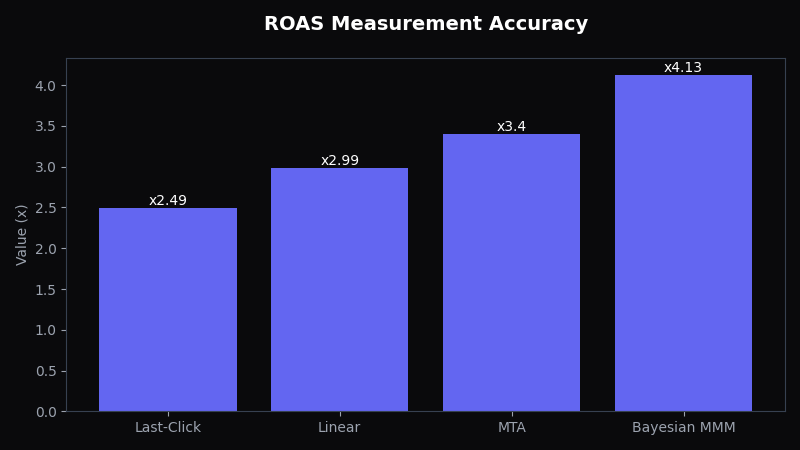
Marketing mix modeling has been around for decades, but the choice between Bayesian and frequentist statistical frameworks is now driving a new wave of differentiation in MMM software. Understanding this distinction matters for any SMB marketer evaluating MMM tools, because it determines what kind of answers you get, how fast you get them, and how actionable they are.
How Do Bayesian and Frequentist Approaches Differ in MMM?
The core difference comes down to how each framework treats probability. Frequentist statistics treats model parameters as fixed but unknown constants and uses sampling distributions to make inferences. Bayesian statistics treats parameters as random variables with their own probability distributions.
In marketing mix modeling, the frequentist approach fits the model once and relies on asymptotic assumptions to construct confidence intervals. Bayesian inference starts with a prior distribution of beliefs about channel effectiveness and updates it with your actual data to produce a posterior distribution.
The Bayesian approach sounds more complex—and historically, it was. Traditional Markov Chain Monte Carlo (MCMC) sampling for Bayesian models could take hours or even days to run on marketing datasets. This made Bayesian MMM the exclusive domain of enterprises with dedicated data science teams and serious computational resources.
OptiMix’s ADVI engine changes this equation entirely. ADVI reformulates the inference problem as an optimization problem, replacing expensive MCMC sampling with a deterministic algorithm that converges reliably and fast.
The Posterior: What Bayesian MMM Actually Gives You
After running OptiMix on your 26+ weeks of spend and revenue data, the Bayesian ADVI engine produces a posterior distribution for every parameter in your model—channel coefficients, saturation curves, carry-over effects, and external variables.
This posterior is not a single number. It is a complete probability distribution that tells you:
- What each channel’s most likely contribution is
- How uncertain the model is about that estimate (via the spread of the posterior)
- How channel contributions correlate with each other (e.g., paid social and organic social moving together)
With frequentist MMM, you typically get point estimates and p-values. The p-value tells you whether an effect is “statistically significant,” but it does not tell you how large the effect likely is or how much confidence you should place in it. The Bayesian posterior captures all of this in one object.
Why Channel Interactions Matter
One of the most practical advantages of Bayesian MMM is how it handles multicollinearity—the tendency of marketing channels to move together. Paid search volume rises when display ads drive brand awareness; social engagement climbs when YouTube campaigns run. These correlations confuse frequentist models and can produce unstable, contradictory coefficient estimates.
Bayesian MMM handles this more gracefully because the prior distribution acts as a regularizer. When the data cannot unambiguously determine a channel’s isolated contribution, the prior pulls the estimate toward a reasonable default. This prevents the wild, unstable coefficients that make frequentist MMM results difficult to act on.
Practical Implications for SMB Marketers
For an SMB marketer running 2–5 channels, Bayesian MMM via OptiMix delivers:
- Results in minutes, not hours. No waiting for MCMC chains to converge.
- Confidence intervals that tell a complete story. Not just whether an effect exists, but how confident you should be about its magnitude.
- Interpretable outputs. The posterior distribution can be visualized directly, showing marketing stakeholders exactly where the model has high conviction and where it needs more data.
- SMB-friendly workflow. No MCMC tuning, no statistical expertise required to interpret results.
Most importantly, the 26-week minimum data requirement is specifically calibrated to give the Bayesian ADVI engine enough information to produce reliable posterior estimates. Shorter windows introduce too much noise for any method to separate signal from marketing volatility.
Key Takeaways
- Bayesian MMM provides full posterior distributions; frequentist MMM provides point estimates and p-values.
- ADVI makes Bayesian MMM computationally tractable by replacing MCMC with fast, deterministic optimization.
- Confidence intervals from Bayesian MMM are more interpretable and actionable than frequentist p-values for marketing decisions.
- OptiMix’s SMB-friendly pricing ($499/month) makes Bayesian MMM accessible without a data science team.
Ready to see the difference Bayesian MMM makes for your marketing budget? Start a free OptiMix trial and run your own data →
This post is part of OptiMix’s introductory series on Bayesian marketing mix modeling. For a comprehensive technical foundation, see our pillar guide to Bayesian marketing mix modeling. For SMB-specific use cases, see Marketing Mix Modeling for Small Business.
Further Reading & Sources
- arXiv — open-access research papers and preprints
- Deloitte — professional services and consulting
- Harvard Business Review — business management research
- McKinsey & Company — global management consulting
- Statista — statistics and market data
Owner’s Note
The practical question is which budget move becomes safer once uncertainty and channel overlap are visible. Before changing the budget, compare the article’s framework with your own last 30 to 90 days of spend, revenue, and qualified outcomes. The best next move should be small enough to test, clear enough to measure, and tied to profit rather than platform-reported activity.
Leave a Reply