
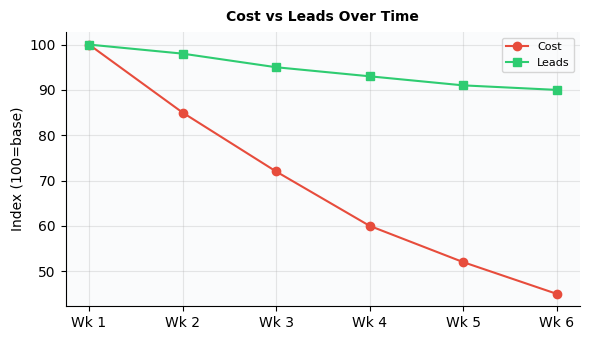
Every business owner eventually asks: “Can I spend less on ads without losing sales?” The answer is yes, but it requires a surgical approach — not a blunt cut. According to McKinsey, companies that optimize ad spend strategically maintain 80% of their lead volume while reducing costs by 20-30%. The blunt approach (cutting 20% across the board) typically loses 30-40% of leads because it removes both waste and working campaigns. Here’s how to cut surgically.
The Difference Between Surgical and Blunt Cutting
Blunt cutting means reducing your budget across all campaigns equally. It’s fast, simple, and almost always hurts lead volume more than it helps the bottom line. Surgical cutting means identifying the specific campaigns, channels, and tactics that are burning money without delivering results — and eliminating only those.
Example: A business spending $10,000/month across 10 campaigns. Blunt cutting by 20% reduces spend to $8,000 but keeps all 10 campaigns running underfunded. Surgical cutting identifies that 3 campaigns (spending $3,000 total) have a ROAS below 1.5x. Pausing those saves $3,000 while preserving 85% of lead volume — because the $3,000 was generating less than $4,500 in revenue anyway.
Surgical Tactic 1: Bid Adjustments by Device, Time, and Location
Most ad platforms allow you to adjust bids based on device type (mobile vs. desktop), time of day, and geographic location. According to Google’s own data, 40% of businesses have significant performance differences between mobile and desktop traffic — yet most never adjust their bids for device type. A service business might find that desktop traffic converts at 3x the rate of mobile traffic. By reducing mobile bids by 50% and increasing desktop bids by 20%, they can maintain total lead volume while reducing total ad spend.
How to implement: Pull your conversion data segmented by device, time, and location. Identify segments with below-average conversion rates and reduce bids by 30-50% for those segments. Reinvest the savings into segments with above-average conversion rates. This is a zero-cost optimization that typically improves ROAS by 15-25%.
Surgical Tactic 2: Ad Scheduling to Capture Peak Conversion Windows
Most businesses see clear patterns in when conversions happen. A B2B service provider might get 80% of their leads between 9 AM and 2 PM on weekdays. A restaurant might get conversions between 11 AM and 1 PM and 5-7 PM. Running ads 24/7 when only 4-6 hours per day are productive is a 50-75% waste of budget.
How to implement: Use Google Ads’ ad schedule feature to target specific hours of the day and days of the week. For Facebook, use ad scheduling in your ad set settings. Start by showing ads only during your top 50% of conversion hours, then monitor whether total conversions drop proportionally or less. In most cases, you’ll lose less than 20% of conversions while cutting 50% of non-peak spend.
Surgical Tactic 3: Audience Layering to Eliminate Waste
Broad audiences contain a mix of high-intent buyers and casual browsers. According to Meta, audience layering — applying multiple targeting criteria simultaneously — can reduce cost per acquisition by up to 40% compared to single-criterion targeting. The key is to combine demographics, interests, and behaviors to create a “sweet spot” audience that excludes low-intent users.
How to implement: On Facebook, layer 2-3 interests together. Instead of targeting “small business owners” (too broad), target “small business owners” AND “Facebook Ads” AND “marketing ROI.” Each additional layer narrows the audience but dramatically improves relevance. Test different combinations and monitor both cost per lead and lead quality.
Surgical Tactic 4: Quality Score Optimization
Quality Score is Google’s measure of how relevant your ad is to your audience. Higher Quality Scores mean lower costs. According to Google, improving your Quality Score from 5 to 8 can reduce cost per click by up to 40%. Since lower CPC means more clicks for the same budget, Quality Score optimization directly reduces cost per lead.
How to implement: Focus on the three components: (1) Ad relevance — match your ad text closely to your keywords and landing page. (2) Expected CTR — test compelling headlines that generate clicks. (3) Landing page experience — ensure your page loads fast, is mobile-friendly, and delivers on the ad promise. Use Google’s Keyword Planner to see your current Quality Scores for top keywords.
How Bayesian MMM Makes This Surgical (And Why It Matters)
The challenge with all the tactics above is that they require data — and most small businesses don’t have clean, complete data across all channels. This is where Bayesian MMM comes in. A tool like OptiMix analyzes your full marketing mix across Google, Facebook, email, and other channels, then identifies exactly which channels and tactics are driving profit vs. just getting last-click credit.
According to a Nielsen study, companies that use MMM see an average 20-40% improvement in marketing ROI within the first year simply by reallocating budget from underperforming to overperforming channels. The Bayesian approach is particularly valuable for SMBs because it works with limited data — you don’t need years of historical data to get actionable insights.
Frequently Asked Questions
How to reduce ad spend without losing sales?
Use the surgical approach above: identify underperforming campaigns and pause them, optimize bids by device/time/location, tighten audience targeting, and improve Quality Scores. Blunt cuts across all campaigns will lose sales — surgical cuts preserve your best performers.
How to cut marketing budget and still grow?
Cut from low-performing channels and reinvest in high-performing ones. Most businesses can reduce total spend by 15-25% by eliminating channel waste without affecting growth. The key is to measure return by channel, not by total spend.
What is the fastest way to reduce ad costs?
Review your search terms report and add irrelevant queries as negative keywords. This takes 15 minutes and can reduce wasted spend by 10-30% immediately. Next, switch from broad match to phrase match keywords. These two changes alone can significantly reduce costs.
How much should a small business spend on ads?
5-12% of revenue for product businesses, 10-20% for service businesses. But the right number is the one that generates profitable customer acquisition — not a fixed percentage. Focus on cost per lead and ROAS, not total spend.
Can Bayesian MMM help reduce ad costs?
Yes. Bayesian MMM identifies which channels are actually driving profit vs. getting last-click credit, enabling you to cut unprofitable spend with confidence — and maintain or even increase conversions from your remaining budget. OptiMix is built specifically for SMBs that need this insight without enterprise complexity.
Owner’s Note
The practical question is whether the metric still makes sense after margin, quality, and incrementality are included. Before changing the budget, compare the article’s framework with your own last 30 to 90 days of spend, revenue, and qualified outcomes. The best next move should be small enough to test, clear enough to measure, and tied to profit rather than platform-reported activity.
Leave a Reply