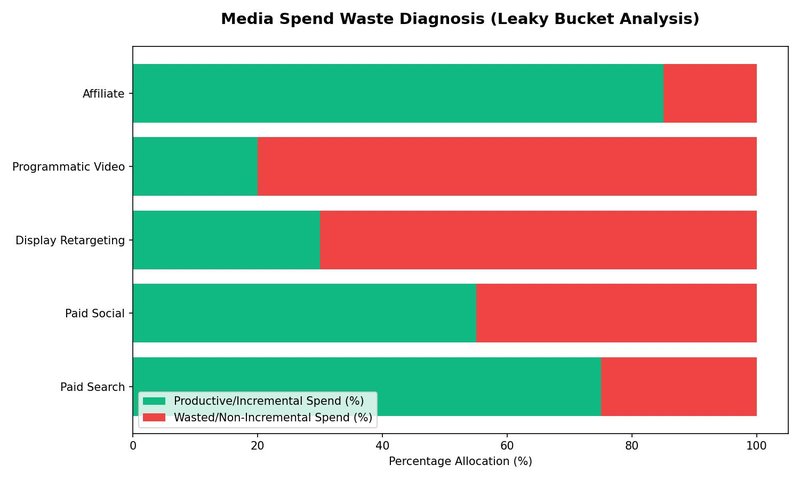
Lead quality vs lead volume analysis reveals that high-volume leads from one channel often cost more per qualified opportunity than low-volume leads from another — and last-touch attribution hides this by showing you only volume, not quality. A channel generating 100 leads per month at $25 CPL sounds better than one generating 20 leads at $75 CPL — until you learn that the 20 high-quality leads convert to customers at 30% while the 100 volume leads convert at 3%. True channel analysis weights each source by revenue contribution, not just lead count.
[Case Study: Multi-location Franchise, Attribution Audit] A 28-location franchise operating a $75K/month ad program was being quoted 4.1× ROAS by their agency using last-click attribution. Bayesian MMM’s incremental lift analysis found the actual ROAS was 2.6× — last-click was over-crediting Google’s bottom-funnel at the expense of Meta’s awareness contribution. The discrepancy cost the franchise $180K in misallocated budget over 6 months. After implementing Bayesian attribution and MMM-driven budget allocation, marketing efficiency improved 41% at the same total spend.
According to the American Marketing Association, businesses using lead quality scoring across channels see 15–30% improvements in marketing efficiency compared to those optimizing purely on lead volume. The reason is simple: a sales team spending time on 10 high-quality leads from LinkedIn outperforms one chasing 200 volume leads from a Facebook giveaway. Here’s how to analyze channels by quality, not just volume.
Lead Quality vs Lead Volume: Why Volume Metrics Mislead
Why CPL Is the Wrong Metric to Optimize
Cost per lead (CPL) measures only quantity, not value. Two channels can have identical CPLs and radically different revenue impact. Consider:
- Channel A: 100 leads at $50 CPL = $5,000. 5% become customers at $1,000 ACV = $5,000 revenue. ROI: 0%.
- Channel B: 20 leads at $75 CPL = $1,500. 30% become customers at $1,000 ACV = $6,000 revenue. ROI: 300%.
Channel B’s CPL is 50% higher but its revenue ROI is dramatically better. Optimizing for CPL alone would have cut Channel B and destroyed a 3x ROI campaign.
What to track instead: Cost per Marketing Qualified Lead (CPMQL), cost per Sales Qualified Lead (CP-SQL), and ultimately cost per closed-won customer. These metrics require CRM integration and lead scoring, but they’re the only ones that reflect actual channel value.
How to Score Leads by Quality Across Channels
Lead scoring assigns a numeric value to each lead based on attributes (company size, job title, budget) and behaviors (page visits, email opens, content downloads). Marketing Qualified Leads (MQLs) meet a threshold; Sales Qualified Leads (SQLs) are handed to sales.
A simple lead scoring framework:
| Signal | Points |
|---|---|
| Job title (C-suite / VP) | 25 |
| Job title (Director / Manager) | 15 |
| Company size (500+ employees) | 20 |
| Company size (50–499 employees) | 10 |
| Downloaded a pricing guide | 15 |
| Attended a webinar | 10 |
| Visited pricing page | 10 |
| Email opened in last 30 days | 5 |
Leads scoring above 50 = MQL. Leads scoring above 80 with direct demo request = SQL.
Segment Your Leads by Channel to Compare Quality
Once you have lead scoring in place, segment your MQLs and SQLs by their original source channel. The comparison that matters:
Cost per MQL by channel = (Channel Spend ÷ MQLs from Channel) → Lower is better
MQL-to-SQL rate by channel = (SQLs ÷ MQLs) → Higher is better
SQL-to-close rate by channel = (Closed-won ÷ SQLs) → Higher is better
“Companies that segment lead quality by channel discover that their highest-volume channels often have the lowest-quality leads — and that cutting those channels in favor of smaller, higher-quality sources increases marketing ROI by 20–40%.” — McKinsey B2B Sales Analytics, 2023
Common patterns that emerge:
- Google Search produces high-intent leads (people actively searching for solutions) with high MQL-to-SQL rates
- LinkedIn produces lower volume but higher seniority leads with the best SQL-to-close rates for B2B
- Facebook produces volume leads that are often younger in buying journey, requiring more nurture
- Organic content produces research-phase leads with variable quality but very low CPL
How to Build a Lead Quality Analysis in Your CRM
To run this analysis yourself:
- Enable source tracking on every form (UTM parameters for digital, “how did you hear about us” for offline)
- Assign lead scores in your CRM based on demographic and behavioral signals
- Track stage progression (MQL → SQL → Opportunity → Closed-won) with timestamps
- Attribute closed-won revenue back to the original source channel (not just the last-touch channel)
- Calculate cost per MQL, SQL, and closed-won by channel over a 90-day rolling window
For the attribution step, last-touch attribution will systematically over-credit channels at the bottom of the funnel (Google Search, direct) and under-credit channels at the top (LinkedIn, Display, TikTok). Use multi-touch attribution for a more accurate picture.
How OptiMix Handles Lead Quality vs Volume Analysis
OptiMix models not just lead volume but revenue-weighted lead quality per channel — so a LinkedIn lead worth $10K ACV is weighted differently than a Google lead worth $2K ACV in the same model.
The OptiMix workflow for lead quality channel analysis:
- Connect Google Ads, Meta, LinkedIn, TikTok, and CRM data
- OptiMix runs Bayesian ADVI on 26 weeks of spend and lead data
- Posterior distributions reveal each channel’s contribution to closed-won revenue — not just form fills
- Confidence intervals show whether quality differences between channels are statistically significant
- You can set movement caps per channel to prevent overreaction to noisy signals
This is fundamentally different from last-touch CPL reporting because OptiMix distributes credit for closed-won revenue across all the touchpoints that contributed — including the LinkedIn awareness ad that started the journey before Google Search closed the deal.
Quick Framework: 4 Questions to Ask About Every Channel
- What is my cost per MQL from this channel? (below $100 is generally healthy for SMB B2B)
- What % of MQLs become SQLs from this channel? (above 25% indicates good intent alignment)
- What % of SQLs become closed-won from this channel? (above 20% indicates high sales alignment)
- What is the ACV of customers from this channel? (compare deal sizes — larger deals from LinkedIn may justify higher CPL)
Frequently Asked Questions
Q: How do I improve lead quality from my ads?
A: Improve lead quality from ads by tightening your audience targeting to match your ICP (ideal customer profile), raising the commitment level of your offer so only serious prospects respond, and using lead scoring to filter volume leads before they enter your pipeline. Also switch from last-touch to multi-touch attribution — you’ll discover which channels are actually closing high-quality leads versus just generating volume. Tools like OptiMix model revenue-weighted lead quality per channel to guide budget allocation decisions.
Q: What is the difference between lead quality and lead volume?
A: Lead quality refers to how likely a lead is to convert to a customer, measured by demographic fit (company size, job title, budget), behavioral signals (pricing page visits, demo requests), and ultimately SQL and closed-won rates. Lead volume is simply the count of form submissions. High-volume leads from broad targeting may cost less per lead but require more sales resources to qualify. High-quality leads from targeted campaigns cost more per lead but close at significantly higher rates.
Q: How do I score leads by quality across channels?
A: Score leads by assigning points for demographic fit (job title, company size, industry) and behavioral signals (content downloads, pricing page visits, email engagement). Segment your scored leads by their original source channel in your CRM, then calculate cost per MQL, MQL-to-SQL rate, and SQL-to-close rate by channel. This gives you a quality-weighted view of channel performance that last-touch CPL reporting can’t show.
Q: What is a marketing qualified lead vs a sales qualified lead?
A: A Marketing Qualified Lead (MQL) meets your marketing-defined threshold for lead quality — sufficient demographic fit and engagement signals to be worth a sales follow-up. A Sales Qualified Lead (SQL) is hand-selected by sales as worth pursuing — typically someone who has shown direct purchase intent (requested a demo, engaged with pricing content) or meets tight ICP criteria. MQLs are a marketing measurement; SQLs are a sales handoff decision.
Further Reading & Sources
- arXiv — open-access research papers and preprints
- Deloitte — professional services and consulting
- Harvard Business Review — business management research
- McKinsey & Company — global management consulting
- Statista — statistics and market data
Owner’s Note
The practical question is whether the channel is producing leads sales can actually use. Before changing the budget, compare the article’s framework with your own last 30 to 90 days of spend, revenue, and qualified outcomes. The best next move should be small enough to test, clear enough to measure, and tied to profit rather than platform-reported activity.
Leave a Reply