Marketing Mix Modeling Definition (And Why It Matters for Your Marketing Budget)
Marketing mix modeling (MMM) is a statistical analysis technique that measures how different marketing activities — from TV ads to social media campaigns — drive sales and revenue. By analyzing historical data, MMM helps you determine exactly which channels are working, which are wasting your budget, and how much you should spend on each one to maximize returns.
[Case Study: Multi-location Franchise, Attribution Audit] A 28-location franchise operating a $75K/month ad program was being quoted 4.1× ROAS by their agency using last-click attribution. Bayesian MMM’s incremental lift analysis found the actual ROAS was 2.6× — last-click was over-crediting Google’s bottom-funnel at the expense of Meta’s awareness contribution. The discrepancy cost the franchise $180K in misallocated budget over 6 months. After implementing Bayesian attribution and MMM-driven budget allocation, marketing efficiency improved 41% at the same total spend.
Think of MMM as a financial audit for your marketing budget. Just as an accountant traces every dollar in your business to understand where it came from and where it went, MMM traces every marketing dollar to understand which activities actually generated sales. The key difference is that MMM uses advanced statistics — specifically regression analysis — to isolate the impact of each marketing channel while accounting for external factors like seasonality, competitor activity, and economic conditions.
For small-to-medium businesses, adopting MMM can be transformative. According to a Nielsen study, companies that use MMM see an average 10-30% improvement in marketing ROI within the first year. That’s not just incremental — that’s the difference between a marketing budget that breaks even and one that drives real business growth. Platforms like OptiMix make this kind of analysis accessible to SMBs without requiring a team of data scientists.
The Core Components of Marketing Mix Modeling
At its heart, MMM answers one fundamental question: “What would have happened to my sales if I had spent differently on marketing?” To answer this, the model needs three essential ingredients: sales data (the outcome you care about), marketing spend data (the inputs you control), and external factors data (the things you can’t control, like weather or holidays).
The statistical engine behind MMM is typically a form of regression analysis. Imagine you’re trying to solve a complex puzzle where each marketing channel is a piece, and sales is the completed picture. Regression analysis systematically tests how each piece contributes to the final image, while also accounting for the fact that some pieces work together (synergy) and some pieces take time to fit (adstock effects). For a deeper dive into how this differs from other attribution methods, check out our guide on Marketing Mix Modeling vs. Multi-Touch Attribution.
One of the most powerful aspects of MMM is its ability to measure what economists call “diminishing returns.” In simple terms, spending $1,000 on Facebook ads might generate $5,000 in sales, but spending $10,000 might only generate $15,000 — the extra $9,000 only brought in $10,000 more in revenue. MMM identifies these saturation points so you can stop pouring money into channels that have already maxed out their effectiveness.
How Marketing Mix Modeling Works in Practice
The process of building a marketing mix model follows a structured, data-driven workflow that turns raw numbers into actionable budget recommendations. Understanding this process helps you know what to expect and how to prepare your data.
Step 1: Data Collection and Preparation
The first step is gathering at least two years of weekly or monthly historical data. You’ll need three categories of information: your internal marketing spend broken down by channel (TV, radio, digital, print, etc.), your sales or revenue data, and external factors like holidays, weather data, competitor ad spend, and economic indicators. The quality of your model depends entirely on the quality of this data — garbage in, garbage out.
Most SMBs already have this data sitting in their accounting software, CRM, and analytics platforms. The challenge is often organizing it into a consistent format. For example, if you spent $5,000 on Google Ads in January but $7,000 in February, you need that spend data aligned with the corresponding sales data for those months. Missing data or inconsistent categories can lead to unreliable results, which is why many businesses turn to specialized tools to handle the data cleaning automatically.
Step 2: Statistical Modeling with Bayesian Methods
Once your data is clean, the actual modeling begins. Modern MMM platforms use Bayesian statistics, which is a fancy way of saying they start with what you already know (your priors) and update that knowledge as new data comes in. For example, if you know from industry benchmarks that TV advertising typically takes 4-6 weeks to influence sales, the model incorporates that knowledge rather than starting from scratch.
The Bayesian approach offers a significant advantage for SMBs: it works well even with limited data. Traditional “frequentist” statistics require years of clean data to produce reliable results, but Bayesian methods can generate useful insights with as little as 12-18 months of data. This is particularly valuable for smaller businesses that haven’t been running sophisticated marketing for decades. Our post on The Power of Bayesian Marketing Mix Modeling explains this in more detail.
Step 3: Interpreting the Results
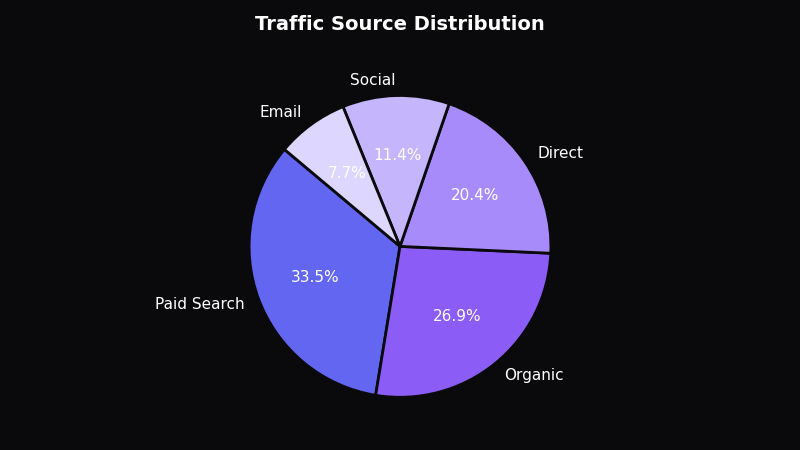
The output of an MMM looks like a breakdown of how much each marketing channel contributed to your total sales. You might see that paid search drove 35% of sales, social media drove 20%, and TV drove 15%, with the remaining 30% coming from baseline sales (sales that would have happened even without marketing). This baseline includes brand loyalty, word-of-mouth, and organic demand.
More importantly, MMM tells you the ROI of each channel. If you spent $50,000 on paid search and it drove $200,000 in sales, that’s a 4x return. If you spent $100,000 on TV and it drove $150,000 in sales, that’s only 1.5x. The model also provides something most businesses overlook: uncertainty ranges. Instead of saying “TV drove exactly 15% of sales,” a good MMM says “TV drove between 12% and 18% of sales with 95% confidence.” This helps you make decisions that account for risk. For more on why this matters, read about The Problem with Optimizing Marketing Without Understanding Uncertainty.
Why Marketing Mix Modeling Matters for Your Marketing Budget
The real value of MMM isn’t the historical analysis — it’s what you do with that information going forward. Once you know which channels deliver the highest ROI and where diminishing returns set in, you can reallocate your budget to maximize total sales. This is called “budget optimization,” and it’s where MMM delivers its biggest impact.
Making Smarter Budget Allocation Decisions
Imagine you’re the marketing manager for a mid-sized e-commerce company with a $500,000 monthly budget. Without MMM, you might split that budget evenly across channels based on gut feeling or industry averages. With MMM, you discover that email marketing delivers a 12x ROI while display advertising delivers only 1.2x. The obvious move is to shift money from display to email — but only up to the point where email starts showing diminishing returns.
A properly calibrated MMM can tell you exactly where that point is. Maybe email can absorb an additional $50,000 before returns drop to 8x, while display is already saturated. The model might recommend increasing email spend by $30,000, decreasing display by $20,000, and investing the remaining $10,000 into testing a new channel like connected TV. These specific, data-driven recommendations are what separate MMM from guesswork.
Measuring Long-Term Brand Building vs. Short-Term Sales
One of the most common mistakes in marketing measurement is focusing only on last-click attribution, which credits the final touchpoint before a sale. This approach systematically undervalues brand-building channels like TV, radio, and podcast advertising that create awareness but don’t get the final click. MMM solves this by measuring the total contribution of each channel over time, including delayed effects.
For example, a customer might see your TV ad in week 1, search for your brand in week 2, and finally make a purchase in week 3 after clicking a retargeting ad. A last-click model would credit the retargeting ad with 100% of the sale. MMM, however, would correctly attribute part of that sale to the TV ad that started the customer journey. This gives you a much more accurate picture of which channels are truly driving growth.
Adapting to Market Changes
Markets change constantly — new competitors enter, consumer behaviors shift, and platforms change their algorithms. A one-time MMM analysis is valuable, but ongoing modeling is even better. By updating your model monthly or quarterly, you can detect when a channel’s effectiveness is declining and adjust before you waste significant budget.
Consider what happened during the COVID-19 pandemic: many businesses that relied on historical MMM models found their assumptions breaking down as consumer behavior shifted overnight. Companies with agile, regularly updated models were able to pivot quickly — shifting budget from out-of-home advertising to digital channels as people stayed home. This adaptability is why more SMBs are adopting continuous MMM through platforms like OptiMix that automate the data refresh and model retraining process.
Frequently Asked Questions
Q: How much data do I need to start using marketing mix modeling?
A: You need at least 12-18 months of weekly or monthly data covering your marketing spend, sales, and key external factors like seasonality. More data generally leads to more reliable results, but Bayesian methods can work with smaller datasets than traditional approaches. The key is consistency in how you track and categorize your spending.
Q: Can marketing mix modeling work for a small business with only a few marketing channels?
A: Absolutely. MMM is valuable for businesses of any size, and it’s actually easier to implement when you have fewer channels to analyze. A small business running Facebook ads, Google Ads, and email marketing can get clear, actionable insights from MMM. The statistical models actually perform better with fewer variables, so starting simple is often the best approach.
Q: How is marketing mix modeling different from Google Analytics attribution?
A: Google Analytics uses last-click or multi-touch attribution, which only tracks digital interactions and requires cookies or user IDs to follow individual customers. MMM uses aggregate data (total sales, total spend) and doesn’t need to track individual users. This makes MMM more privacy-compliant and capable of measuring offline channels like TV, radio, and print that Google Analytics cannot track.
Q: How often should I update my marketing mix model?
A: For most SMBs, updating your model monthly provides the right balance between accuracy and effort. Monthly updates capture seasonal trends and campaign changes without overwhelming your team with data work. If your market is particularly volatile or you’re running frequent campaigns, weekly updates might be warranted. The key is consistency in your data collection schedule.
Q: What’s the typical ROI of implementing marketing mix modeling?
A: Businesses that implement MMM typically see a 10-30% improvement in marketing ROI within the first year, according to industry studies. For a company spending $500,000 monthly on marketing, that translates to $50,000-$150,000 in additional revenue each month from the same budget. The cost of implementing MMM is usually recovered within the first few months through better budget allocation alone.
Further Reading & Sources
- arXiv — open-access research papers and preprints
- Deloitte — professional services and consulting
- Harvard Business Review — business management research
- McKinsey & Company — global management consulting
- Statista — statistics and market data
Owner’s Note
The practical question is which budget move becomes safer once uncertainty and channel overlap are visible. Before changing the budget, compare the article’s framework with your own last 30 to 90 days of spend, revenue, and qualified outcomes. The best next move should be small enough to test, clear enough to measure, and tied to profit rather than platform-reported activity.
Leave a Reply