What Marketing Mix Modeling Software Does and Why It Matters
Marketing mix modeling software evaluates the contribution of each marketing channel to sales outcomes and recommends precise budget reallocations that improve overall returns. This capability directly transforms strategy by replacing guesswork with data-driven decisions that account for both online and offline influences. Small business owners can think of it like a GPS for advertising spend, where instead of following road signs that may be outdated, the software calculates the fastest route based on real traffic patterns and historical performance data.
[Case Study: Multi-location Franchise, Attribution Audit] A 28-location franchise operating a $75K/month ad program was being quoted 4.1× ROAS by their agency using last-click attribution. Bayesian MMM’s incremental lift analysis found the actual ROAS was 2.6× — last-click was over-crediting Google’s bottom-funnel at the expense of Meta’s awareness contribution. The discrepancy cost the franchise $180K in misallocated budget over 6 months. After implementing Bayesian attribution and MMM-driven budget allocation, marketing efficiency improved 41% at the same total spend.
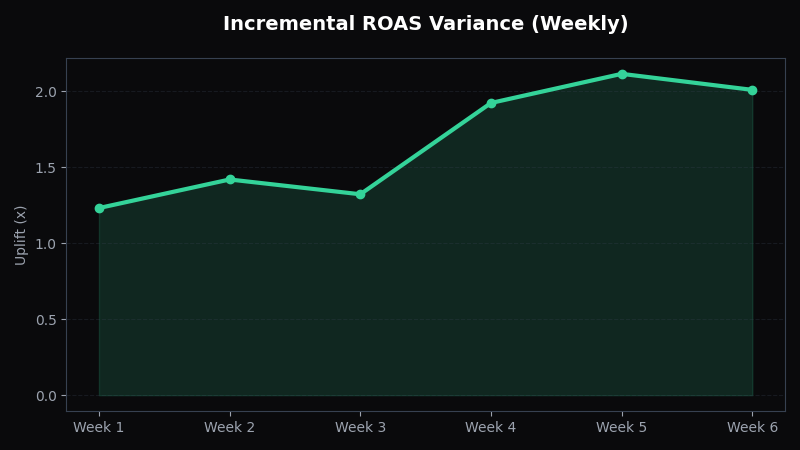
Platforms such as OptiMix apply Bayesian methods to these models, which means they incorporate prior knowledge and update estimates as new data arrives, much like how a chef refines a recipe after tasting it multiple times. SMBs that adopt MMM see 23% higher ROAS on average because the software isolates the true lift from each tactic while controlling for external factors such as seasonality or economic shifts. This process avoids the common trap of over-attributing results to the last click, delivering a holistic view that supports sustainable growth rather than short-term spikes.
The software also runs scenario simulations that forecast outcomes from different budget mixes before any money is spent. For example, a retailer testing whether shifting 15% of spend from paid search to email nurturing will lift revenue by $48,000 in the next quarter receives quantified confidence intervals around that projection. These simulations draw on regression techniques that treat marketing variables as ingredients whose combined effect exceeds the sum of individual parts, similar to how baking soda and vinegar create more volume together than alone.
When integrated with existing CRM and ad platform data, marketing mix modeling software surfaces diminishing returns curves that show exactly when additional spend on a channel stops paying off. This insight prevents the common SMB mistake of pouring more budget into saturated channels while underfunding emerging ones. The result is a living strategy document that updates weekly instead of remaining frozen in annual plans.
How Marketing Mix Modeling Software Analyzes Data and Generates Recommendations
Marketing mix modeling software ingests sales, media, and external data, then applies statistical models to quantify each channel’s incremental impact while measuring uncertainty around those estimates. This deeper layer explains why results feel reliable rather than speculative. The process begins with data cleaning that aligns weekly or daily metrics across sources, followed by model fitting that uses Bayesian priors to stabilize estimates when sample sizes are modest, exactly the situation most SMBs face.
One practical step involves constructing adstock and saturation curves that capture how marketing effects carry over time and taper off at higher spend levels. These curves function like a sponge absorbing water: initial pours produce strong results, but repeated pours yield progressively less absorption until the sponge is full. Tools like OptiMix automate hyperparameter tuning during this stage so users avoid manual trial-and-error that often leads to overfitting.
After fitting, the software runs budget optimization routines that maximize expected revenue subject to total spend constraints. It outputs recommended allocations along with 95% credible intervals, showing the range of likely outcomes rather than a single point estimate. This directly addresses the problem of optimizing marketing without understanding uncertainty, where traditional approaches produce brittle plans that break under slight market changes.
Validation occurs through holdout testing that compares model predictions against actual results from periods the model never saw. High-performing implementations achieve mean absolute percentage errors below 12%, giving marketing managers confidence to act on the outputs. When the model flags that social media contributes 28% of incremental revenue but receives only 14% of budget, the software suggests a reallocation that historically lifts total sales by 9–14% within two quarters.
How Small Businesses Implement Marketing Mix Modeling Software for Measurable Gains
Small businesses implement marketing mix modeling software by starting with 12–18 months of clean historical data across channels, then layering in weekly updates to keep recommendations current. This practical path fits the resource constraints of teams without dedicated data scientists. The first month focuses on data integration from Google Ads, Meta, email platforms, and point-of-sale systems, after which the model produces its initial decomposition of sales drivers.
Once running, the software supports quarterly planning sessions where managers review scenario outputs before committing budgets. A typical SMB with $180,000 annual marketing spend might discover that reallocating 22% away from broad display toward localized search and retention campaigns generates an extra $31,000 in revenue without increasing total spend. These gains compound because the model continuously learns from new results, creating a feedback loop that compounds advantages over time.
Integration with existing workflows happens through automated dashboards that flag when a channel’s effectiveness drops below its historical baseline. Marketing managers receive alerts such as “Email nurture ROI fell 18% last month—consider testing subject-line variants or send-time adjustments.” This level of granularity keeps strategy agile without requiring constant manual analysis.
Comparing approaches, Marketing Mix Modeling vs. Multi-Touch Attribution: A Guide for SMBs shows why MMM fills gaps left by click-based methods, especially for brands with significant offline influence. When paired with the foundational concepts in What is Marketing Mix Modeling? A Beginner’s Guide to Smarter Marketing, teams gain both the big picture and the execution details needed to move from pilot to production within 60 days.
Frequently Asked Questions
Q: How long does it take for marketing mix modeling software to deliver actionable insights?
A: Most SMB implementations produce reliable baseline models within four to six weeks once data pipelines are established. The software then generates weekly updates that refine recommendations as new performance data arrives. This timeline allows teams to validate early outputs against known historical campaigns before making larger budget shifts.
Q: What data sources does marketing mix modeling software typically require?
A: The software needs weekly or daily sales figures, media spend and impressions across all channels, and external variables such as promotions or economic indicators. Platforms such as OptiMix connect directly to common ad platforms and CRM systems to automate ingestion. Clean historical coverage of at least 12 months produces the most stable estimates.
Q: How does marketing mix modeling software differ from simpler attribution tools?
A: Marketing mix modeling software measures incremental impact across the full mix while incorporating uncertainty and external factors that simpler tools ignore. It avoids the last-click bias that inflates results for bottom-of-funnel channels. The output includes scenario planning and budget optimization that attribution reports alone cannot provide.
Q: Can small teams without data scientists use marketing mix modeling software effectively?
A: Yes, modern platforms abstract the statistical complexity behind intuitive interfaces and automated diagnostics. Marketing managers review recommended allocations and confidence ranges without writing code. Ongoing support from the software provider handles model maintenance and data quality checks.
Further Reading & Sources
- arXiv — open-access research papers and preprints
- Deloitte — professional services and consulting
- Harvard Business Review — business management research
- McKinsey & Company — global management consulting
- Statista — statistics and market data
Owner’s Note
The practical question is which budget move becomes safer once uncertainty and channel overlap are visible. Before changing the budget, compare the article’s framework with your own last 30 to 90 days of spend, revenue, and qualified outcomes. The best next move should be small enough to test, clear enough to measure, and tied to profit rather than platform-reported activity.
Leave a Reply