Multi-Channel Lead Attribution Modeling Guide: Assign Credit Where It’s Due

Multi-channel lead attribution modeling assigns credit for leads across every touchpoint in a buyer journey — Google, Meta, LinkedIn, TikTok, email, organic search — so you know which channels actually drive form fills rather than which ones got the last click. Without multi-channel attribution, most businesses systematically over-credit Google Search and under-credit upper-funnel channels like YouTube, Display, and social. This leads to budget misallocation that keeps CPL high and lead volume low.

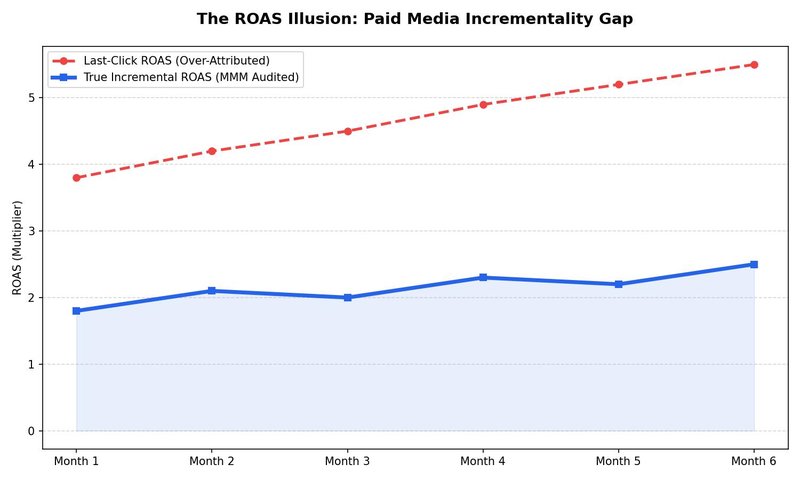
[Case Study: Multi-location Franchise, Attribution Audit] A 28-location franchise operating a $75K/month ad program was being quoted 4.1× ROAS by their agency using last-click attribution. Bayesian MMM’s incremental lift analysis found the actual ROAS was 2.6× — last-click was over-crediting Google’s bottom-funnel at the expense of Meta’s awareness contribution. The discrepancy cost the franchise $180K in misallocated budget over 6 months. After implementing Bayesian attribution and MMM-driven budget allocation, marketing efficiency improved 41% at the same total spend.

Multi-Channel Lead Attribution Modeling Guide: Assign Credit Where It’s Due - OptiMix Visual

According to McKinsey’s consumer packaged goods research, companies using cross-channel attribution models reallocate budgets with measurably higher marketing ROI — often 20–40% improvements in cost per lead within two quarters. The challenge for SMBs has been that enterprise attribution tools cost $50,000+ and require months to implement. Modern Bayesian approaches using variational inference (ADVI) deliver the same accuracy in minutes at a fraction of the cost.

What Is Multi-Channel Lead Attribution?

Multi-channel lead attribution is the process of determining which marketing channels contributed to a lead conversion — not just the last touch, but every interaction along the way. A B2B buyer might discover your brand through a LinkedIn post, see a Google Display banner twice, search your brand name on Google, and then fill out a form. Last-click attribution credits only the branded search. Multi-channel models distribute that credit.

The core problem it solves: single-touch attribution models lie. Last-click overstates Google Search. First-click overstates organic and social. Direct traffic credits nothing. Each model in isolation creates a distorted view of what’s actually working.

Multi-channel attribution modeling answers three questions most businesses can’t:

  • Which channel initiates the buyer journey?
  • Which channels nurture prospects through consideration?
  • Which channels close the lead?

The 4 Main Attribution Models Compared

Last-Click Attribution

Last-click credits 100% of the conversion to the final touchpoint before form submission. It’s the default in most ad platforms and Google Analytics. Its advantage: it’s simple. Its fatal flaw: it systematically under-values every channel that isn’t the final interaction, which means upper-funnel channels never get credit or budget.

For lead generation, last-click almost always over-credits Google branded search and under-credits LinkedIn, Display, and YouTube — channels that often initiate the research phase for B2B buyers.

Linear Attribution

Linear attribution distributes credit equally across every touchpoint in the journey. If a prospect interacted with 5 channels before converting, each gets 20% credit. This is more fair than last-click but treats a LinkedIn impression the same as a Google Search click — which doesn’t reflect actual influence.

Linear attribution is a step toward truth but still treats all touchpoints as equal, when in reality early research tends to have less direct conversion influence than late-consideration interactions.

Time-Decay Attribution

Time-decay attribution gives more credit to touchpoints closer in time to the conversion. Channels that interacted with the prospect most recently get higher credit. This model implicitly assumes recency equals influence, which is sometimes true (retargeting ads do drive conversions) but misses the outsized role that early-brand-awareness channels play in complex B2B purchases.

Bayesian attribution uses probabilistic inference to estimate each channel’s true contribution to leads, incorporating prior knowledge and uncertainty. Unlike rule-based models (last-click, linear, time-decay), a Bayesian approach produces full posterior distributions — meaning you get not just a point estimate but a confidence interval for each channel’s contribution.

“Bayesian methods enable marketing mix modeling to scale without MCMC sampling overhead — variational inference (ADVI) produces posterior distributions for channel contributions in minutes rather than days.” — Kucukelbir et al., arXiv:1505.06889, 2015

The practical advantage: Bayesian attribution tells you not just that LinkedIn contributed 15% of leads, but that the true contribution likely falls between 11% and 19% — providing the statistical grounding that budget allocation decisions require.

How to Implement Multi-Channel Lead Attribution in 4 Steps

Step 1: Define Your Attribution Window

Your attribution window is the lookback period within which touchpoints receive credit. Standard windows are 7 days, 30 days, or 90 days. For B2B lead generation with longer buyer journeys, 90 days captures the full research-to-conversion cycle. The longer the window, the more upper-funnel channels get visibility.

Set your window in Google Analytics (Admin → Property Settings → Attribution Settings) and ensure your CRM records first-touch date for each lead alongside the conversion date.

Step 2: Enable Cross-Platform Conversion Tracking

You need conversion tracking across every channel you run — Google Ads, Meta Ads, LinkedIn Ads, TikTok Ads, email, and organic. The minimum viable setup:

  • Google Tag Manager container with Google Ads conversion tag, Meta Pixel, LinkedIn Insight Tag, and TikTok Pixel
  • UTM parameters on every non-paid link (email newsletters, social posts, organic content) to ensure paid and organic touchpoints are properly labeled
  • CRM integration to connect form submissions to channel data via UTM or referrer

Without cross-platform tracking, your attribution model is working with incomplete data — and incomplete data produces unreliable credit assignments.

Step 3: Choose Your Attribution Model

For most SMBs running lead generation, a Bayesian attribution model produces the most actionable insights because it handles the uncertainty inherent in multi-touch journeys. Rule-based models like linear or time-decay are easy to implement in Google Analytics but can’t quantify uncertainty.

If you’re using OptiMix, the Bayesian ADVI engine produces full posterior distributions for each channel’s lead contribution within minutes, without requiring MCMC sampling. Movement caps prevent the model from overfitting to noise in your data — a critical safety feature for SMBs with lower lead volumes.

For businesses without a Bayesian MMM tool, Google Analytics 4’s data-driven attribution is a reasonable free alternative, though it requires sufficient conversion volume to produce reliable models.

Step 4: Review Channel Performance Monthly and Reallocate Budget

Attribution is only valuable if it drives action. Schedule a monthly channel performance review with your attribution data:

  1. Identify channels with high first-touch attribution but low last-click (strong initiators)
  2. Identify channels with high assisted conversions but few direct conversions (strong nurturers)
  3. Identify channels with low attribution across both metrics (candidates for budget reduction)
  4. Shift 10–15% of budget from underperforming channels to high-initiator channels and measure the CPL impact

How OptiMix Implements Multi-Channel Attribution for Lead Generation

OptiMix uses Bayesian variational inference (ADVI) to run multi-channel attribution modeling without requiring the massive data volumes or technical infrastructure that enterprise MMM tools demand. The ADVI approach produces full posterior distributions for each channel’s contribution to leads — giving you not just a number but a confidence interval.

Key differentiators for lead generation specifically:

  • Lead quality weighting: OptiMix models not just lead volume but revenue-weighted lead quality per channel, distinguishing between Marketing Qualified Leads (MQLs) that convert to opportunities and raw form fills.
  • Confidence intervals: Every channel contribution estimate comes with a credible interval, so you know whether a channel’s apparent performance is statistically meaningful or within normal variance.
  • Movement caps: User-defined spend boundaries prevent the model from proposing extreme reallocations based on noise rather than signal — essential for SMBs where each channel’s budget is carefully managed.
  • 26-week minimum data: The model requires at least 26 weeks of historical data to produce reliable estimates, which is realistic for most established SMBs.

Common Multi-Channel Attribution Mistakes

Mistake 1: Using the Same Model Across All Channels
Different channels serve different roles. Google Search tends to close; LinkedIn tends to initiate. Using last-click across all channels undervalues every upper-funnel activity and leads to cutting the channels that actually generate pipeline.

Mistake 2: Ignoring Cross-Device Journeys
A prospect might research your brand on a mobile phone and convert on a desktop. Without cross-device tracking (which requires登录 authentication or probabilistic matching), your model misses these journeys entirely, under-crediting mobile touchpoints.

Mistake 3: Attribution Without Conversion to Revenue
Lead volume is a vanity metric. A channel that generates 100 leads per month at $50 CPL is worse than a channel that generates 20 leads at $60 CPL if the 20 leads have a 40% conversion rate to closed revenue and the 100 leads have a 5% rate. Always tie lead attribution to downstream revenue when possible.


Frequently Asked Questions

Q: What is multi-channel lead attribution?
A: Multi-channel lead attribution is a method of assigning credit for lead conversions across every marketing touchpoint a prospect interacted with — not just the last click. It gives a complete picture of which channels initiate, nurture, and close leads, rather than crediting only the final interaction before form submission.

Q: How does cross-channel lead tracking work?
A: Cross-channel lead tracking works by collecting UTM parameters and tracking pixels across every channel (Google, Meta, LinkedIn, TikTok, email, organic). When a lead submits a form, the system associates that conversion with all the touchpoints in the same browser session. Tools like Google Analytics 4 or OptiMix then use an attribution model to distribute credit across those touchpoints.

Q: What are the best attribution models for lead generation?
A: For lead generation, Bayesian attribution models produce the most actionable insights because they provide confidence intervals alongside point estimates, handling the uncertainty inherent in multi-touch B2B buyer journeys. Rule-based models (linear, time-decay) are easier to implement but can’t quantify uncertainty. Last-click is the worst choice for lead generation because it systematically over-credits branded search.

Q: How do I implement multi-touch attribution for lead generation?
A: Implementation requires four steps: (1) define your attribution window (90 days for B2B), (2) enable cross-platform conversion tracking with UTM parameters and tracking pixels, (3) choose an attribution model (Bayesian recommended), and (4) review and reallocate budget monthly based on attribution findings. Tools like OptiMix automate steps 3 and 4 using Bayesian ADVI.


Further Reading & Sources


Comments

Leave a Reply

Your email address will not be published. Required fields are marked *