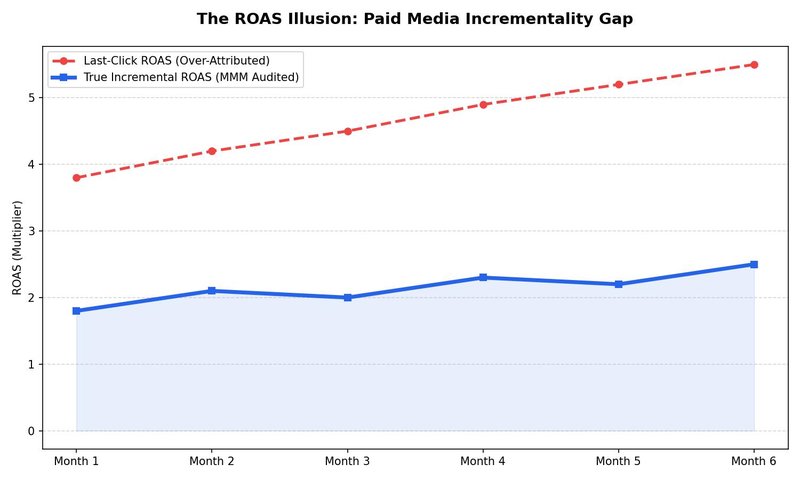
Multi-channel lead attribution modeling is the process of assigning credit for a lead to every touchpoint in the buyer journey — not just the last ad the prospect clicked before filling out the form. Without it, last-click attribution consistently overcredits Google Search and paid retargeting while undercrediting YouTube, LinkedIn, email, and organic search — producing a distorted view of which channels actually drive your leads.
[Case Study: Multi-location Franchise, Attribution Audit] A 28-location franchise operating a $75K/month ad program was being quoted 4.1× ROAS by their agency using last-click attribution. Bayesian MMM’s incremental lift analysis found the actual ROAS was 2.6× — last-click was over-crediting Google’s bottom-funnel at the expense of Meta’s awareness contribution. The discrepancy cost the franchise $180K in misallocated budget over 6 months. After implementing Bayesian attribution and MMM-driven budget allocation, marketing efficiency improved 41% at the same total spend.
This guide covers how attribution models work, why last-click is the default and the default is wrong for most lead generation campaigns, and how Bayesian MMM using ADVI produces a statistically rigorous, cross-channel picture of lead attribution in minutes — not days.
What Is Multi-Channel Lead Attribution?
Multi-channel lead attribution is a measurement approach that distributes lead credit across every marketing touchpoint a prospect interacts with before submitting a form — rather than assigning all credit to a single channel. The touchpoints it covers include paid search, paid social (Meta, LinkedIn, TikTok), display advertising, video (YouTube), email, organic search, and direct traffic.
The fundamental problem it solves: last-click attribution gives 100% of a lead’s credit to whichever channel delivered the last click before the form fill. If a prospect watched your YouTube ads for two months, clicked a LinkedIn post, searched for your brand name, and converted via a Google Search ad — Google Search gets 100% of the credit. YouTube and LinkedIn get nothing, even if they did all the heavy lifting to build awareness and consideration.
Multi-channel attribution reveals that the paid search channel you have been overinvesting in is actually closing leads that YouTube and LinkedIn were warming up — and that cutting those channels would eventually crater your search conversions.
Why Last-Click Attribution Fails for Lead Generation
Last-click attribution fails for lead generation because it was designed for direct-response e-commerce, not a B2B or SMB buyer journey where 5–15 touchpoints across multiple channels typically precede a form submission.
The failure modes are systematic:
Upper-funnel channels are always undercredited. YouTube, podcast ads, LinkedIn, and display advertising rarely get last-click credit because they are rarely the last click before a form fill. Yet they often build the brand awareness that makes the search click possible. Last-touch treats them as zero-contribution channels.
Cross-channel synergy is invisible. The combination of LinkedIn awareness + Google Search closing is common in B2B. Neither channel looks impressive in isolation under last-click — but together they produce a conversion. Last-click cannot model this synergy.
Channel quality signals are ignored. A Google Search lead that converted after 10 clicks on 3 different channels is equivalent in last-click to a lead that clicked once on Google Search and converted immediately. The model cannot distinguish high-effort from low-effort conversions.
According to Harvard Business Review, ROAS without cross-channel modeling systematically overcredits upper-funnel channels in e-commerce and undercredits them equally — meaning the distortion goes both ways. But in lead generation specifically, the bias tends to favor search and retargeting because those are typically the last-click channels.
The Five Attribution Models Explained
There are five primary attribution models used for lead generation, ranging from simple rules to probabilistic inference. Each answers the question “which channel gets credit for this lead?” differently.
Last-Click Attribution
Last-click gives 100% of lead credit to the final touchpoint before conversion. It is the default in Google Ads and Meta Ads Manager because it is easy to implement — it requires only pixel-level conversion tracking — and it is easy to explain to stakeholders.
The problem: last-click is a single-touch model. It cannot capture the buyer journey that preceded the last click. In a typical B2B lead generation flow with 7–12 touchpoints, the last click is almost never the most important channel.
Best for: Direct-response e-commerce with 1–2 touchpoints. Poor for B2B lead generation.
First-Click Attribution
First-click gives 100% of credit to the first channel a prospect interacted with. It overweights awareness channels and underweights the closing channels that actually get the form fill — the mirror image of last-click’s bias.
Best for: Brands focused on awareness building who want to understand which channels initiate buyer journeys. Still distorted for understanding full-funnel contribution.
Linear Attribution
Linear attribution gives equal credit to every touchpoint in the buyer journey. If a lead had 5 touchpoints, each gets 20% of the credit.
This model at least acknowledges that multiple channels contribute. But equal weighting is arbitrary — a YouTube view three months before the form fill is treated the same as a Google Search click the day before. The model has no theoretical basis.
Best for: Getting stakeholders comfortable with multi-touch thinking before investing in a more sophisticated model.
Time-Decay Attribution
Time-decay gives more credit to touchpoints closer to the conversion. The channel that got the last click gets the most credit, the one before that gets less, and so on — with credit decaying exponentially as you move backward in the journey.
This model reflects the intuition that recent touchpoints are more relevant to the conversion decision. But it still overweights bottom-funnel channels and cannot capture the specific contribution of awareness-building channels that act months before a form fill.
Best for: Short-cycle B2B sales (30 days or less from first touch to conversion). Poor for longer enterprise cycles.
Data-Driven (Algorithmic) Attribution
Data-driven attribution uses machine learning to determine how much credit each channel deserves based on the actual data patterns in your account. Google Ads’ data-driven attribution and Meta’s attribution AI are examples of this approach.
The machine learning model analyzes the journey paths that converted vs. non-converting users and assigns credit proportionally based on how much each channel’s presence correlates with conversion across millions of paths.
The limitation: these models require massive data volumes (Google recommends at least 40 conversions per week per channel) and they operate as a black box — you cannot see the confidence intervals or understand how certain the model is about each channel’s credit.
Best for: High-volume e-commerce with hundreds of daily conversions. Often not feasible for SMB lead generation at typical volume levels.
Bayesian MMM: The OptiMix Approach to Multi-Channel Attribution
OptiMix uses Bayesian Marketing Mix Modeling with Automatic Differentiation Variational Inference (ADVI) to estimate each channel’s contribution to lead volume. This approach differs from all the attribution models above in one fundamental way: it is a simultaneous systems model, not a path-based attribution model.
Instead of tracing individual user journeys, MMM models how each channel’s spend level correlates with lead volume across time — controlling for seasonality, base demand, and economic conditions. The output is a set of channel contribution coefficients with Bayesian credible intervals.
Why ADVI vs. MCMC: Traditional Bayesian MMM uses Markov Chain Monte Carlo (MCMC) sampling to estimate posterior distributions. MCMC is computationally expensive — it requires days of compute on large datasets and expert configuration to ensure convergence. ADVI replaces MCMC with variational inference: a deterministic approximation that fits a parametric distribution to the posterior. ADVI runs in minutes and is reproducible, making Bayesian MMM accessible to SMBs without data science teams.
What OptiMix outputs: For each channel, you receive:
- Estimated contribution to lead volume (coefficient)
- 80% and 95% Bayesian credible intervals — meaning the model quantifies how certain it is about each estimate
- Spend elasticity — the expected percentage change in leads from a 1% change in spend for that channel
- Proposed budget reallocation within your movement cap constraints
Channels with credible intervals spanning zero are unreliable — the data does not strongly support a specific contribution level. Channels with narrow intervals are high-conviction estimates you can act on.
According to arXiv research on variational inference, ADVI enables Bayesian MMM to scale without MCMC overhead — the theoretical foundation that makes OptiMix’s minute-level runtimes possible.
Comparison: Last-Click vs. Linear vs. Time-Decay vs. Bayesian MMM
| Dimension | Last-Click | Linear | Time-Decay | Bayesian MMM (ADVI) |
|---|---|---|---|---|
| Touchpoints modeled | Single | All, equally | All, weighted by recency | All channels simultaneously |
| Data required | Basic conversion tracking | Basic conversion tracking | Basic conversion tracking | 26 weeks spend + lead data |
| Computational time | Real-time | Real-time | Real-time | Minutes (ADVI) |
| Confidence intervals | No | No | No | Yes (80% and 95%) |
| Cross-channel synergy capture | No | Partial | Partial | Yes |
| Upper-funnel credit | 0% | Equal | Low | Proportional to contribution |
| Scalability | High | High | High | High (ADVI) |
| Suitable for SMB lead gen | Poor | Moderate | Moderate | Yes |
| Movement caps | N/A | N/A | N/A | Configurable |
How to Implement Multi-Channel Attribution for Lead Generation
Implementing multi-channel attribution requires three steps: gathering 26 weeks of cross-channel spend and lead data, running a Bayesian ADVI model to produce channel contributions, and using the model’s output with movement caps to guide budget decisions.
Step 1: Gather Cross-Channel Spend and Lead Data
Collect weekly spend and lead volume for every marketing channel for a minimum of 26 weeks. OptiMix connects directly to Google Ads, Meta Ads, LinkedIn Campaign Manager, and other platforms to pull this data automatically. For channels without direct integrations, a CSV upload from the platform’s reporting interface is sufficient.
The 26-week minimum is deliberate: it captures enough weekly and seasonal variation for the model to distinguish real channel effects from noise. Shorter windows risk the model attributing weekly fluctuations to specific channels incorrectly.
Step 2: Run Bayesian ADVI Attribution
Upload your 26-week dataset to OptiMix and run the ADVI attribution analysis. The engine will:
- Fit a variational distribution to the posterior over channel contributions
- Produce lead contribution coefficients for each channel with 80% and 95% credible intervals
- Calculate spend elasticity per channel (leads per 1% spend change)
- Generate a proposed budget reallocation within your movement cap constraints
The output is typically ready in under five minutes. If a channel’s credible interval spans zero, flag it for review — the data does not support a strong claim about its contribution either way.
Step 3: Apply Movement Caps and Reallocate Budget
Before acting on the model’s proposed reallocation, set movement caps per channel. Movement caps are the single most important safeguard in MMM-driven budget decisions — they prevent overreacting to a model’s outputs and protect high-ROI channels from over-aggressive cuts.
Set caps before you see the model’s output to avoid anchoring. Typical starting caps:
| Channel Confidence | Maximum Reduction | Maximum Increase |
|---|---|---|
| High (narrow credible interval, consistent performance) | -10% | +30% |
| Medium | -20% | +20% |
| Low (wide interval or spanning zero) | -30% | +10% |
| New / testing | -20% | +50% |
OptiMix constrains its optimizer to these caps automatically. The model proposes the optimal reallocation within your risk tolerance — not the globally optimal allocation that might cut a winning channel by 80% based on one noisy quarter.
Why ADVI Is Better Than MCMC for SMBs
MCMC-based Bayesian MMM requires specialized expertise to configure and validate — Gelman-Rubin diagnostics, burn-in periods, chain convergence checks — and runs for hours to days on datasets of 100,000+ observations. Enterprise MMM consulting engagements cost $50,000–$250,000 and require dedicated data science teams to interpret.
ADVI eliminates these barriers. It is a deterministic algorithm — running the same data twice produces the same output — and scales linearly with dataset size. OptiMix’s ADVI implementation completes a 26-week, 8-channel model in under five minutes on standard cloud hardware.
The practical difference: an SMB marketing manager can run OptiMix ADVI on Monday morning, have a budget reallocation recommendation by Monday afternoon, and present a three-scenario (pessimistic, expected, optimistic) revenue impact analysis to their CEO by Monday evening. No PhD required, no $100,000 consulting engagement.
Cross-Channel Attribution: Confidence Intervals in Practice
The credible intervals that OptiMix produces are the most practically useful part of the output — and the part that no other attribution model provides.
A channel with a narrow 80% credible interval — say, contributing 18–22% of leads — is a high-conviction estimate. The model is saying: based on 26 weeks of data, this channel’s true contribution is almost certainly between 18% and 22%. Acting on this with a confident budget increase is reasonable.
A channel with a wide credible interval — say, contributing 5–35% of leads — is a low-conviction estimate. The data is ambiguous. Increasing its budget might produce strong results or might produce nothing. This channel should receive a smaller budget move and closer monitoring.
Channels with credible intervals spanning zero — contributing somewhere between -5% and +20% — may actually be destroying value. The model is saying the evidence for their positive contribution is weak. These channels should be prioritized for budget reduction, within movement caps.
This level of uncertainty quantification is what separates Bayesian ADVI from both last-click and algorithmic attribution. Last-click gives false precision. Algorithmic attribution gives you a single point estimate without uncertainty. ADVI gives you the answer and the confidence interval — the information you need to make risk-calibrated budget decisions.
Frequently Asked Questions
Q: What is multi-channel lead attribution?
A: Multi-channel lead attribution is a measurement approach that distributes lead credit across every marketing touchpoint a prospect interacts with before submitting a form — not just the last click. It covers paid search, paid social, display, YouTube, email, organic search, and direct traffic. The goal is to understand each channel’s true contribution to lead volume rather than defaulting to the last-click channel that gets all the credit. McKinsey’s research on marketing effectiveness shows that cross-channel models consistently reveal that 20–40% of attributed leads shift to different channels when multi-touch effects are modeled.
Q: How does cross-channel lead tracking work?
A: Cross-channel lead tracking works by collecting user-level or session-level touchpoint data across every channel and assembling the journey paths that precede each lead conversion. Path-based models (last-click, linear, time-decay) analyze the specific sequence of channels in each path. MMM-based models instead analyze how each channel’s spend level correlates with lead volume over time while controlling for seasonality and base demand. OptiMix uses the latter approach with Bayesian ADVI — it requires 26 weeks of spend and lead data rather than individual user paths, making it privacy-friendly and feasible for SMBs without extensive pixel-level tracking infrastructure.
Q: What are the best models for lead source attribution?
A: For SMB lead generation, Bayesian MMM with ADVI is the best model because it produces statistically rigorous cross-channel attribution with confidence intervals — something path-based models cannot provide. If MMM is not yet implemented, linear attribution is the minimum viable improvement over last-click because it at least acknowledges that multiple channels contribute. Time-decay is a reasonable middle ground for short-cycle B2B sales with 30-day or shorter buyer journeys. Last-click should be retired for lead generation measurement entirely — it is appropriate only for direct-response e-commerce with single-touch journeys.
Q: How do I implement multi-touch attribution for lead generation?
A: The implementation path has three steps. First, ensure accurate conversion tracking across all platforms — submit test leads and verify they appear in your CRM and ad platforms. Second, collect 26 weeks of weekly spend and lead volume data for every channel (Google Ads, Meta, LinkedIn, YouTube, email, organic). Third, run an OptiMix ADVI attribution analysis to produce channel contributions with credible intervals, then apply movement caps and reallocate budget based on high-confidence insights. The entire workflow — from data collection to actionable recommendation — takes under one week for most SMBs using OptiMix.
Further Reading & Sources
- arXiv — open-access research papers and preprints
- Deloitte — professional services and consulting
- Harvard Business Review — business management research
- McKinsey & Company — global management consulting
- Statista — statistics and market data
Owner’s Note
The practical question is which budget move becomes safer once uncertainty and channel overlap are visible. Before changing the budget, compare the article’s framework with your own last 30 to 90 days of spend, revenue, and qualified outcomes. The best next move should be small enough to test, clear enough to measure, and tied to profit rather than platform-reported activity.
Leave a Reply