Small-business ad budgets usually get built in one of two ways. Either last month’s winner gets more money, or every channel gets roughly the same split because no one wants to make the wrong call.
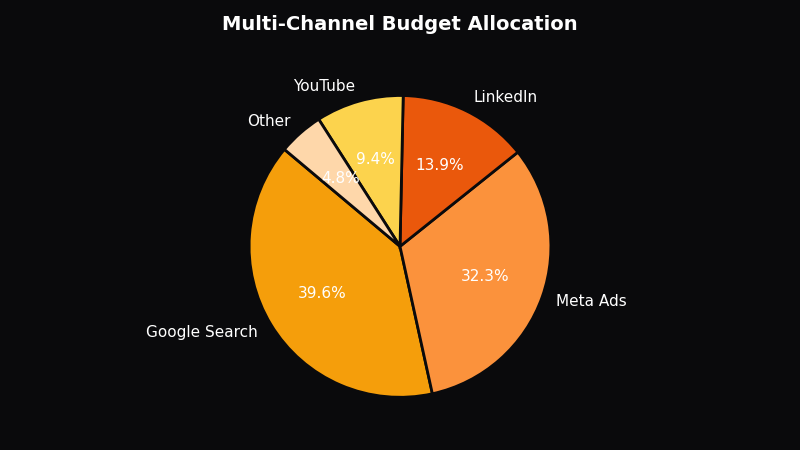
Both approaches feel reasonable. Both can quietly waste money.
How to optimize ad budget for small business is not really a question about which platform is best. It is a question about where the next dollar is most likely to create profitable, incremental revenue. Google, Meta, LinkedIn, email, local sponsorships, and direct mail can all work. The right mix depends on your margins, sales cycle, customer behavior, and how saturated each channel already is.
Start With the Constraint
Before shifting money between channels, define the constraint you are optimizing around. Are you trying to grow revenue, protect cash flow, lower customer acquisition cost, improve lead quality, or reduce wasted spend? A budget plan built for aggressive growth will look different from one built for margin protection.
Owners often say they want “more ROI,” but the business may actually need something more specific: fewer low-quality leads, less dependence on one platform, or a lower ad cost ratio. Name the constraint first so the budget has a job.
Sort Channels by Business Role
Each channel should have a role. Branded search captures existing demand. Non-branded search finds people with active intent. Paid social can create demand and retarget people who need more time. Email often monetizes demand you already earned. Offline and local channels may build trust in ways a dashboard will not fully capture.
When every channel is judged by the same last-click ROAS standard, the budget usually drifts toward bottom-funnel channels. That can make reports look better while starving the channels that create future demand.
Use a Three-Part Budget Score
For each channel, score three things:
- Incremental impact: would revenue fall if this channel lost budget?
- Marginal return: is the next dollar still productive, or is the channel saturated?
- Profit quality: are the customers profitable after discounts, fulfillment, and sales cost?
A channel with average ROAS but strong incremental impact may deserve more budget. A channel with excellent ROAS but little incremental lift may deserve less. This is where many small businesses find hidden waste.
A Simple Reallocation Method
- Protect the base. Keep enough budget in channels that reliably produce profitable demand.
- Cap saturated spend. Stop increasing budgets where cost per acquisition rises faster than revenue.
- Trim over-credited channels. Review branded search, retargeting, and email before assuming they created the sale.
- Fund controlled tests. Move a small percentage into channels or offers with upside, not random experiments.
- Review after a full buying cycle. Some channels show impact with a lag.
Where MMM Helps
Marketing mix modeling helps when platform dashboards disagree or when you cannot tell whether a channel is creating demand or just claiming it. A Bayesian MMM estimates channel contribution across time and gives uncertainty ranges, which is especially useful for smaller businesses with noisy data.
The point is not to make marketing academic. The point is to make budget decisions calmer. Instead of asking which dashboard looks best, you can ask which channel is most likely to improve the business if it receives the next dollar.
How to Use the First Month of Data
Once you make a budget change, give it enough time to show up in the business. For a fast e-commerce store, that might mean two to four weeks. For a local service company or B2B business, it may mean a full sales cycle. The point is to avoid changing everything every few days and then wondering why the signal is noisy.
Track four numbers after each reallocation: total spend, total revenue, qualified leads or orders, and contribution profit. Platform ROAS can stay in the report, but it should not be the only judge. If revenue is flat and profit is weaker, a “good” ROAS is not good enough.
A Practical Starting Allocation
If you do not know where to begin, start with a conservative split. Protect the channel that reliably captures existing demand, reserve a meaningful portion for demand creation, and keep a small testing budget for new offers or audiences. For many small businesses, that may look like 60% proven acquisition, 25% demand creation, and 15% controlled experiments. The exact numbers matter less than the discipline of giving each dollar a job.
The mistake is putting 100% of the budget into the channel that won last month. That creates dependency and makes it harder to discover where the next stage of growth will come from.
The Takeaway
Optimizing ad budget for a small business means moving from habit to evidence. Give each channel a role, judge it by incremental contribution and profit quality, and reallocate in measured steps. The best budget is not the one that makes every platform happy. It is the one that makes the business stronger.
What to Do This Week
Take one practical step with the budget line item with the weakest evidence. Pull the last 30 to 90 days of spend, revenue, qualified leads, and any notes about promotions or sales changes. Then write one sentence that explains what you believe is happening. For example: “This channel is creating new demand,” “this campaign is capturing demand we already had,” or “this spend is not showing up in qualified outcomes.”
Next, choose a small test that could prove or disprove that sentence. That might mean trimming budget by 10%, changing the offer, separating branded from non-branded traffic, improving the landing page, or comparing platform-reported conversions with CRM results. Keep the test narrow enough that you can learn from it.
Good budget work usually feels less dramatic than a big cut. It is the steady process of moving dollars away from weak evidence and toward decisions the business can actually defend.
Leave a Reply