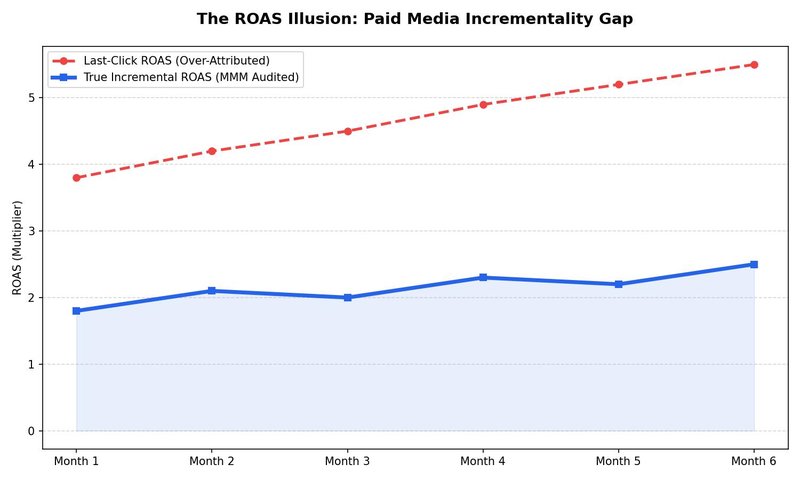
The Sugar Rush of High ROAS
We have all felt it. You log into your Facebook Ads Manager or Google Ads dashboard and see a campaign with a 5.0 ROAS (Return on Ad Spend). You put in $1, and you got $5 back. It feels amazing. It feels like printing money.
[Case Study: Multi-location Franchise, Attribution Audit] A 28-location franchise operating a $75K/month ad program was being quoted 4.1× ROAS by their agency using last-click attribution. Bayesian MMM’s incremental lift analysis found the actual ROAS was 2.6× — last-click was over-crediting Google’s bottom-funnel at the expense of Meta’s awareness contribution. The discrepancy cost the franchise $180K in misallocated budget over 6 months. After implementing Bayesian attribution and MMM-driven budget allocation, marketing efficiency improved 41% at the same total spend.
So, you do the logical thing: you double the budget. You wait for sales to double. But they don’t. Maybe they go up by 10%, or maybe they don’t move at all. You stare at the dashboard, confused. The dashboard says you made money. Your bank account says you spent money. Who is lying?
The Doorman Fallacy: Why Attribution Fails
The problem isn’t that the data is wrong; it’s that the attribution is greedy. To understand why, let’s look at the “Doorman Fallacy.”
Imagine you own a popular nightclub. You hire a doorman and pay him $1 for every person he counts walking inside. At the end of the night, he claims he brought in 500 people. He demands $500.
But here is the catch: those people were already in line. They were coming in whether the doorman was there or not. He didn’t generate the traffic; he just claimed it.
This is exactly how Retargeting and Branded Search campaigns often work. If someone searches for your brand name on Google, they are already in line. If you pay for an ad to sit at the top of that search result, Google will claim credit for the sale. But that sale was likely going to happen anyway (organically).
Incrementality: The Only Metric That Matters
This is where Bayesian Marketing Mix Modeling (MMM) changes the game. Unlike platform dashboards, which fight to claim credit, MMM measures Incrementality.
Incrementality asks a simple, brutal question: “If we turned this ad off, would these sales disappear?”
When you use a tool like OptiMix, you might discover that your “best performing” Facebook campaign is actually just a digital doorman, taxing customers who were already going to buy. Meanwhile, a “low performing” YouTube campaign might be the one actually convincing strangers to get in line.
How to Fix Your Budget Today
Stop scaling based on vanity metrics. Here is how to start spending on truth:
- Audit Your Branded Spend: Are you spending more than 10% of your Google budget on your own brand name? Try cutting it in half and see if total revenue drops.
- Look for “Assist” Channels: Use MMM to identify channels that drive awareness (top of funnel) but don’t get the final click. These are often undervalued by 30-40%.
- Test, Don’t Guess: Run geo-lift tests. Turn off ads in one state and keep them on in another. Measure the difference in total revenue, not just ad clicks.
Stop Paying the Doorman
High ROAS is seductive, but Incremental ROI is what pays the bills. If you are ready to see which of your ads are working and which are just standing by the door, it’s time to move beyond the dashboard.
Frequently Asked Questions
What is a good ROAS?
A “good” ROAS depends on your profit margins, but typically a 4:1 ratio is considered healthy for e-commerce. However, a high ROAS on branded search is often misleading (low incrementality).
How does MMM measure incrementality?
MMM uses statistical regression to isolate the impact of media spend on sales, controlling for seasonality and trends. It calculates the lift generated above your baseline organic sales.
Related Articles
- Why Attribution is Lying to You: The Case for Bayesian MMM
- How to Cut Your Advertising Waste by 30% Using Bayesian MMM
- The Real Cost of Misattributed Ad Spend: Why Your ROAS Lies
Further Reading & Sources
- arXiv — open-access research papers and preprints
- Deloitte — professional services and consulting
- Harvard Business Review — business management research
- McKinsey & Company — global management consulting
- Statista — statistics and market data
Owner’s Note
The practical question is whether the metric still makes sense after margin, quality, and incrementality are included. Before changing the budget, compare the article’s framework with your own last 30 to 90 days of spend, revenue, and qualified outcomes. The best next move should be small enough to test, clear enough to measure, and tied to profit rather than platform-reported activity.
Leave a Reply