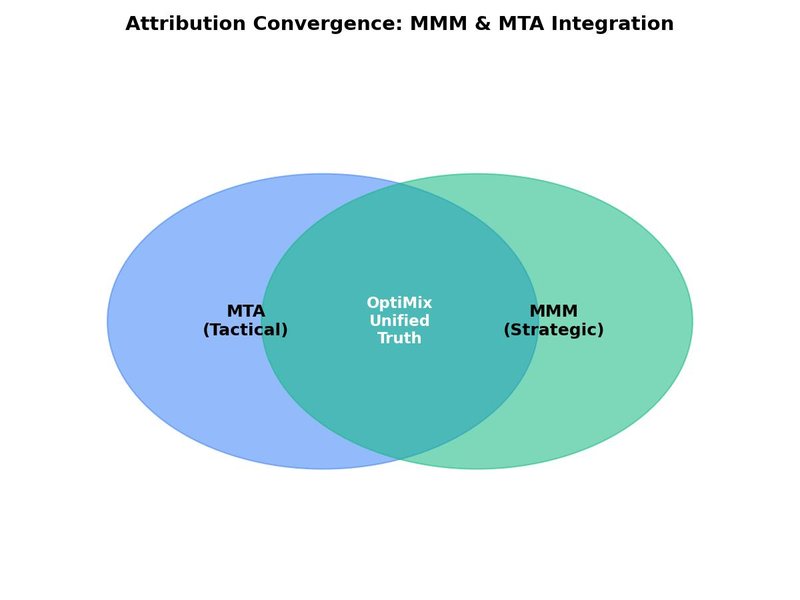
If you have ever looked at your Facebook Ads Manager and your Google Ads dashboard only to see that they are both claiming credit for the same sale, you are not alone. This is the attribution trap, and it is costing small and medium businesses (SMBs) thousands of dollars in wasted ad spend every month.
[Case Study: Multi-location Franchise, Attribution Audit] A 28-location franchise operating a $75K/month ad program was being quoted 4.1× ROAS by their agency using last-click attribution. Bayesian MMM’s incremental lift analysis found the actual ROAS was 2.6× — last-click was over-crediting Google’s bottom-funnel at the expense of Meta’s awareness contribution. The discrepancy cost the franchise $180K in misallocated budget over 6 months. After implementing Bayesian attribution and MMM-driven budget allocation, marketing efficiency improved 41% at the same total spend.
The Doorman Fallacy
Imagine a restaurant. A customer decides to eat there because they saw a glowing review in a local magazine. They walk to the restaurant, and as they reach the door, the doorman opens it for them. If that restaurant used digital tracking logic, the doorman would get 100% of the credit for bringing that customer in.
This is exactly how tracking pixels work. They give credit to the last thing the customer touched, completely ignoring the brand building and cross-channel influence that actually drove the decision. We call this the “Doorman Fallacy.”
The Solution: Bayesian Marketing Mix Modeling (MMM)
Instead of trying to follow every individual customer with privacy-invasive and increasingly inaccurate tracking pixels, OptiMix uses Bayesian Marketing Mix Modeling. This statistical approach looks at your aggregate data—your spend across all channels and your total sales—to find the true mathematical relationship between them.
It is like a chef tasting a soup. They do not need to track every individual grain of salt to know if the soup is too salty; they taste the final result and adjust the ingredients accordingly. MMM gives you that same top-down perspective on your marketing.
Why OptiMix is Different for SMBs
Traditionally, MMM was a luxury reserved for Fortune 500 companies with massive data science teams. OptiMix changes that. Our Bayesian engine is built specifically to handle the smaller, noisier datasets typical of SMBs, providing clear, actionable insights without the need for a PhD.
- Stop Overspending: Identify channels that are overclaiming credit and move that budget to what is actually working.
- Respect Privacy: MMM does not rely on individual tracking, making it 100% future-proof against privacy changes like iOS 14+.
- Scale with Confidence: Know exactly how much your next dollar of ad spend will return before you spend it.
Frequently Asked Questions
What data do I need for MMM?
You simply need your historical spend by channel and your sales data. OptiMix handles the rest.
Does this replace Google Analytics?
No, MMM complements your existing tools. While GA tells you what happens on your site, OptiMix tells you which ad dollars actually drove people there in the first place.
How long does it take to see results?
Most businesses can get their first model running and see optimization opportunities within the first week of using OptiMix.
Ready to see the truth behind your ad spend? Visit optimix.aureliansystems.tech to get started.
Related Articles
- The ROAS Illusion: Why High-Performing Ads Might Be Wasting Your Budget
- How to Cut Your Advertising Waste by 30% Using Bayesian MMM
- The Real Cost of Misattributed Ad Spend: Why Your ROAS Lies
Further Reading & Sources
- arXiv — open-access research papers and preprints
- Deloitte — professional services and consulting
- Harvard Business Review — business management research
- McKinsey & Company — global management consulting
- Statista — statistics and market data
Owner’s Note
The practical question is which budget move becomes safer once uncertainty and channel overlap are visible. Before changing the budget, compare the article’s framework with your own last 30 to 90 days of spend, revenue, and qualified outcomes. The best next move should be small enough to test, clear enough to measure, and tied to profit rather than platform-reported activity.
Leave a Reply