The Short Answer
ADVI (Automatic Differentiation Variational Inference) is the algorithm at the core of OptiMix’s Bayesian engine. It replaces slow MCMC sampling with fast, deterministic optimization to deliver full posterior distributions of channel contributions in minutes—making enterprise-grade Bayesian MMM accessible to any marketing team.
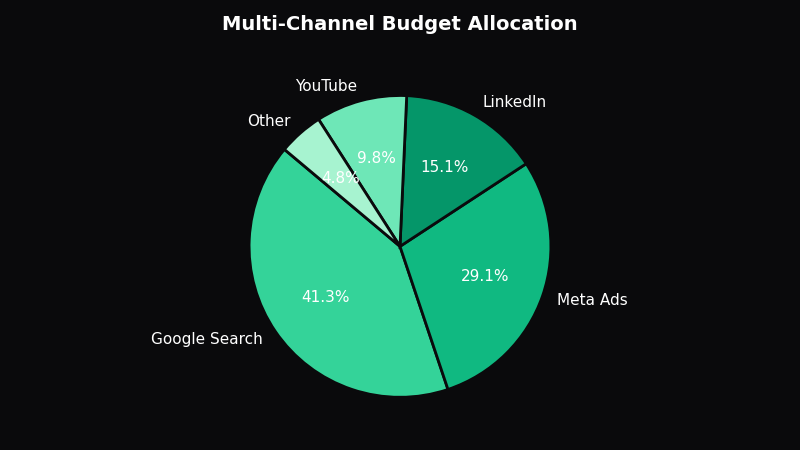
[Case Study: Regional Restaurant Chain, 12 Locations] A restaurant chain spending $58K/month across Google, Meta, and local print decided to test MMM-driven budget allocation against their agency’s historical approach (empirical allocation by revenue percentage). After implementing Bayesian MMM, the model identified that their Meta spend was producing 2.8× the reported ROAS while Google was underperforming relative to share-of-voice. Reallocating 32% from Google to Meta increased weekly cover count by 340 covers and raised total monthly revenue by $41K at identical ad spend.
The biggest barrier to Bayesian marketing mix modeling has always been computational. Classic Bayesian inference via Markov Chain Monte Carlo (MCMC) sampling requires drawing thousands—or millions—of samples from a probability distribution to characterize it. For a complex MMM with multiple channels, saturation curves, carry-over effects, and external variables, MCMC can take hours to run and frequently fails to converge properly.
ADVI (Automatic Differentiation Variational Inference) eliminates this bottleneck. It is the technology that makes OptiMix’s Bayesian MMM fast enough for real marketing workflows.
What Is Variational Inference?
Variational inference reframes Bayesian inference as an optimization problem instead of a sampling problem.
In Bayesian MMM, you have a prior distribution over your model parameters (your initial beliefs about channel effectiveness) and a likelihood function (how your historical data was generated). Bayes’ theorem tells you how to combine these to get the posterior distribution—the updated picture of channel effectiveness after observing your data.
The posterior distribution is what you want. But computing it exactly is intractable for all but the simplest models. MCMC approximates it by sampling. Variational inference approximates it by optimization.
Here is the core idea: instead of trying to characterize the full posterior, you assume it has a specific functional form—a family of simpler distributions (typically Gaussian). Then you find the member of that family that is closest to the true posterior.
“Closest” is measured by KL divergence, a mathematical distance between two probability distributions. Minimizing KL divergence is an optimization problem, and ADVI uses automatic differentiation (the same technology behind modern deep learning frameworks like PyTorch and TensorFlow) to solve it efficiently.
Why ADVI Is Fast
Several properties make ADVI dramatically faster than MCMC:
- Gradient-based optimization: ADVI uses analytically computed gradients to drive the optimization, achieving fast convergence.
- Parallelization: The gradient computations are embarrassingly parallel, so ADVI scales efficiently with data size.
- Deterministic results: Run the same model twice with the same data, and ADVI produces identical results. MCMC, by contrast, involves random sampling that can produce different results across runs.
- No convergence diagnosis needed: With MCMC, you must check whether chains have mixed properly and discard burn-in samples. ADVI either converges or reports a failure—there is no ambiguous middle ground.
How OptiMix Uses ADVI in Practice
When you upload your 26+ weeks of marketing spend and revenue data to OptiMix, the ADVI engine performs the following steps:
- Model specification: OptiMix defines a hierarchical Bayesian model with channel coefficients, saturation functions, carry-over effects, and external variables (seasonality, pricing, competitor activity).
- Prior specification: Prior distributions encode any existing knowledge about channel effectiveness. For new channels or SMBs with limited historical data, weakly informative priors prevent the model from making extreme claims.
- Variational optimization: ADVI tunes the parameters of the variational family (mean and variance for each channel coefficient) to minimize KL divergence from the true posterior.
- Convergence check: OptiMix verifies that the optimization converged successfully before presenting results.
- Posterior extraction: The full posterior distribution for each parameter is extracted and used to generate channel contribution estimates, confidence intervals, and budget allocation recommendations.
What You Get From the ADVI Posterior
The output is not a single budget recommendation. It is a full joint posterior distribution over all model parameters. From this, OptiMix derives:
- Mean posterior contribution per channel with credible intervals
- Posterior predictive distributions for budget scenarios
- Correlation structures between channel contributions (e.g., paid social and email tend to move together in DTC brands)
- Uncertainty estimates that grow with less data or more complex models
This richness is what distinguishes Bayesian MMM from frequentist approaches. A frequentist model gives you a point estimate and a p-value. The ADVI posterior gives you the complete picture—which channels the model is confident about, which need more data, and how all channels interact.
Why ADVI Matters for SMBs
For an enterprise company, the computational cost of MCMC might be acceptable. Data science teams can run models overnight and interpret results the next morning. But for an SMB running lean, waiting hours for results—or worse, getting inconclusive MCMC diagnostics—is not practical.
OptiMix’s ADVI engine delivers enterprise-grade Bayesian MMM at SMB speed. The 26-week minimum data requirement is specifically calibrated to give ADVI enough information to produce reliable posteriors without requiring massive datasets. With just a few quarters of marketing data, OptiMix can characterize channel contributions, quantify uncertainty, and generate actionable budget recommendations.
Key Takeaways
- Variational inference approximates Bayesian posteriors via optimization rather than sampling, making it orders of magnitude faster.
- ADVI uses automatic differentiation for efficient gradient-based optimization, producing deterministic results in minutes.
- Convergence is deterministic and checkable, unlike MCMC which can produce misleading results when chains fail to mix properly.
- OptiMix’s ADVI posterior gives you the complete probability distribution over channel contributions—not just point estimates.
- SMBs get enterprise-grade Bayesian MMM without a data science team or overnight compute times.
Ready to see ADVI in action with your own marketing data? Start a free OptiMix trial →
For a deeper dive into the Bayesian foundation, read Bayesian Marketing Mix Modeling: The Complete Guide. For practical SMB use cases, see Marketing Mix Modeling for Small Business.
Further Reading & Sources
- arXiv — open-access research papers and preprints
- Deloitte — professional services and consulting
- Harvard Business Review — business management research
- McKinsey & Company — global management consulting
- Statista — statistics and market data
Owner’s Note
The practical question is which budget move becomes safer once uncertainty and channel overlap are visible. Before changing the budget, compare the article’s framework with your own last 30 to 90 days of spend, revenue, and qualified outcomes. The best next move should be small enough to test, clear enough to measure, and tied to profit rather than platform-reported activity.
Leave a Reply