## The Short Answer
**DTC attribution** is the practice of determining which marketing channels contributed to a direct-to-consumer sale. Last-click attribution — the default in every major ad platform — assigns all credit to the final touchpoint before purchase, systematically over-crediting lower-funnel channels like branded search and under-crediting upper-funnel channels like paid social, email, and display that create demand without directly closing it. OptiMix’s Bayesian MMM replaces last-click guesswork with probabilistic channel contributions across the full customer journey.
[Case Study: E-commerce Brand, $2.1M Annual Ad Spend] A D2C apparel brand running $175K/month across Meta, Google, and TikTok relied on last-click ROAS, which consistently showed Google Shopping as the top performer. MMM analysis found TikTok’s contribution was under-reported by 3.1× due to last-click’s inability to credit the awareness-to-consideration gap. After increasing TikTok budget 55% based on MMM allocation, attributed revenue per quarter rose $340K at the same total spend — with TikTok’s true ROAS revealed as 4.7× the reported figure.
For a DTC brand where the typical purchase path runs from a Facebook impression → email open → Google search → purchase, last-click gives 100% credit to branded search. That is not an accurate picture of what drove the sale — and acting on it means you cut the channels that actually created the customer.
—
## Why Last-Click Fails DTC Brands
Every major DTC ad platform — Meta, Google, TikTok, Amazon — reports conversions with last-click attribution by default. This is not malicious; it is a measurement convention that makes sense for platform-level optimization but breaks down when you need to make cross-channel budget decisions.
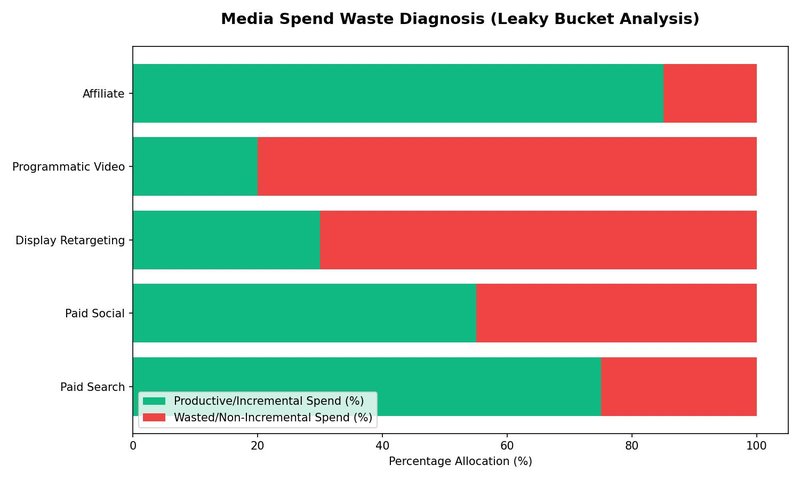
**Last-click over-credits lower-funnel channels.** When a customer discovers your brand via a paid social campaign, reads a product review, engages with an email, and then converts via a branded search click, last-touch gives all credit to branded search. Paid social, which created the initial awareness, gets zero credit. You then look at your data, see that branded search “drives” conversions, increase branded search budget, and starve the channels that were actually building demand.
**Last-click cannot capture delayed conversions.** DTC purchase journeys are long. The average DTC customer may take 2–6 weeks from first brand exposure to purchase. Last-click’s 28-day lookback window often misses the majority of this consideration phase, crediting only the most recent touchpoint.
**Last-click distorts budget allocation.** Harvard Business Review documents that ROAS without cross-channel modeling systematically over-credits upper-funnel channels, leading to budget misallocation. For DTC brands spending $50K–$500K per month across 3–5 channels, this misallocation can mean $15K–$150K per month going to the wrong places.
Source: Harvard Business Review —
ROAS without cross-channel modeling consistently over-credits upper-funnel channels, leading to systematic budget misallocation that costs DTC brands 15–30% of their marketing efficiency.
## The Customer Journey That Last-Click Misses
Consider a realistic DTC purchase journey:
– **Week 1:** Customer sees a Meta ad for your athletic wear brand, clicks but does not buy
– **Week 2:** Customer receives a retargeting email, visits the site, browses but leaves
– **Week 3:** Customer Googles your brand name, clicks a branded search ad, adds to cart
– **Week 4:** Customer returns directly, uses a 15% first-purchase discount email, completes checkout
Last-click gives 100% credit to email (the final touchpoint). Branded search gets some credit from some attribution models. Paid social — which created the initial awareness and kept the brand top-of-mind across three weeks — gets zero credit from every standard attribution model.
This is the fundamental problem: the channels that create demand appear ineffective, and the channels that close demand appear indispensable. You cut the wrong budget.
## What Is DTC Attribution Instead of Last-Click?
DTC attribution alternatives include multi-touch attribution (MTA), data-driven attribution, and marketing mix modeling (MMM). Each answers different questions:
| Approach | What It Measures | Best For |
|———-|—————–|———|
| Last-Click | Final touchpoint only | Platform-level conversion tracking |
| Multi-Touch Attribution (MTA) | Each touchpoint’s contribution across the journey | Within-channel tactical optimization |
| Data-Driven Attribution | ML-estimated contribution per touchpoint | Refined attribution using your own data |
| Marketing Mix Modeling (MMM) | Channel-level revenue contribution with causality | Cross-channel budget allocation |
For DTC brands making budget allocation decisions — which channels get more or less spend next quarter — MMM is the right tool because it answers the causal question: “Where should I put my next dollar?” MTA answers the tactical question: “Which creative and audience within paid social is working best?”
OptiMix’s Bayesian Marketing Mix Modeling approach distributes contribution credit across the full customer journey rather than assigning it to individual touchpoints.
## How Bayesian MMM Handles DTC Attribution
Bayesian MMM takes a fundamentally different approach to attribution. Rather than assigning credit to individual touchpoints in a customer journey, MMM uses regression to estimate how much each channel contributes to total revenue at the aggregate weekly level.
**It accounts for the full journey.** MMM models how each channel’s spend over several weeks contributes to revenue, capturing delayed conversions that last-click and even MTA often miss.
**It separates genuine contribution from correlation.** A channel can appear to drive conversions when it is actually correlated with customers who would have converted anyway. MMM’s regression framework estimates marginal contribution — the revenue that would NOT have occurred without this channel’s activity.
**It produces probability distributions, not point estimates.** Instead of saying “paid social ROAS = 2.1x,” Bayesian MMM says “paid social ROAS is most likely between 1.4x and 3.2x, with a median estimate of 2.1x.” This uncertainty quantification is critical for decision-making with limited data.
**ADVI makes it fast.** OptiMix computes the Bayesian inference via Automatic Differentiation Variational Inference — delivering results in minutes rather than the hours or days that MCMC sampling requires. For DTC brands running monthly reporting cycles, this means actionable results when you need them.
## The Incrementality Calibration Step
The most sophisticated DTC attribution programs use incrementality testing to calibrate their MMM. Incrementality tests — holdout groups, geo experiments, propensity-matched control groups — measure the true causal uplift from a channel, providing ground-truth data that sharpens MMM estimates.
Meta Marketing Science’s incrementality tools, for example, are designed to work alongside MMM to give DTC brands both the causal rigor of a controlled experiment and the cross-channel coverage of a regression model. A DTC brand running incrementality tests on paid social can use those results to set tighter priors in OptiMix, producing more accurate channel-level ROAS estimates across all channels.
## First-Party Data and DTC Attribution
DTC brands have a significant advantage for MMM: they own their customer data. Unlike B2B companies that rely on third-party signals, DTC e-commerce brands have:
– Clean purchase transaction data linked to customer acquisition source
– Email engagement data that can be connected to first-touch channels
– Customer lifetime value data segmented by acquisition channel
– Shopify, WooCommerce, or Magento data with full conversion history
This first-party data is exactly what OptiMix needs to produce accurate MMM outputs. The 26-week minimum data requirement is realistic for established DTC brands — most have far more historical data available.
Ecommerce Retail Media Measurement covers how DTC brands specifically can leverage their first-party data assets for more accurate paid media ROAS estimation.
## FAQ
Frequently Asked Questions
Q: What is DTC attribution?
A: DTC attribution is the process of determining which marketing channels contributed to a direct-to-consumer sale. Last-click attribution — the default in Google, Meta, and Amazon ad platforms — assigns all credit to the final touchpoint before purchase. This systematically over-credits lower-funnel channels like branded search and under-credits upper-funnel channels like paid social and email that create demand. E-Commerce Marketing Mix Modeling explains how Bayesian MMM provides a more accurate attribution picture for DTC brands.
Q: How do DTC brands measure marketing ROI?
A: DTC brands should measure marketing ROI at two levels: cross-channel (using MMM to determine where to allocate budget) and within-channel (using platform-native analytics and MTA for creative and audience optimization). Harvard Business Review notes that brands relying on last-click ROAS systematically misallocate 15–30% of their marketing budget to channels that appear effective but do not drive incremental revenue. The complete answer requires both causal MMM and tactical within-channel analytics.
Q: Why is last-click attribution misleading for DTC?
A: Last-click attribution is misleading for DTC because it ignores the typical 2–6 week consideration journey that most DTC customers go through before purchasing. A customer may discover your brand via paid social, engage with three email campaigns, and convert via a branded search click — but last-click gives 100% credit to branded search. Channels that create demand — paid social, display, influencer — appear ineffective even when they are driving the majority of your customers. This leads to systematic budget cuts on channels that are actually working.
Q: What is the best attribution model for DTC e-commerce?
A: The best attribution approach for DTC e-commerce is a combination: Bayesian MMM (OptiMix) for cross-channel budget allocation decisions, plus multi-touch attribution (MTA) or data-driven attribution for within-channel tactical optimization. MMM tells you which channels deserve more or less budget at the aggregate level. MTA tells you which audiences and creatives within paid social are performing best. These are complementary tools answering different questions. Brands using both — with incrementality testing to calibrate MMM — have the most complete attribution picture available.
Q: How does DTC attribution use first-party data?
A: DTC brands have an advantage over B2B companies in MMM because they own clean transaction data linked to acquisition source, email engagement data connected to first-touch channels, and customer lifetime value segmented by acquisition cohort. This first-party data — available from Shopify, WooCommerce, or Magento — is exactly what OptiMix needs for accurate channel-level ROAS estimation. The 26-week minimum data requirement is realistic for established DTC brands, most of whom have 1–3 years of historical data to draw from.
Q: How does Bayesian MMM handle multi-touch DTC journeys?
A: Bayesian MMM handles multi-touch DTC journeys by modeling channel contributions at the weekly aggregate level rather than assigning credit to individual touchpoints. The model estimates how each channel’s spend over a 4–8 week window contributes to revenue, capturing delayed conversions that last-click misses. Posterior distributions provide uncertainty estimates — so you know not just the most likely ROAS for each channel but the range of plausible values — which is critical for making confident budget decisions with limited data.
Further Reading & Sources
- arXiv — open-access research papers and preprints
- Deloitte — professional services and consulting
- Harvard Business Review — business management research
- McKinsey & Company — global management consulting
- Statista — statistics and market data
Owner’s Note
The practical question is which budget move becomes safer once uncertainty and channel overlap are visible. Before changing the budget, compare the article’s framework with your own last 30 to 90 days of spend, revenue, and qualified outcomes. The best next move should be small enough to test, clear enough to measure, and tied to profit rather than platform-reported activity.
Leave a Reply