## The Short Answer
**Ecommerce retail media measurement** is the practice of quantifying how effectively paid media channels — paid social, search, email, and display — drive revenue for online retailers, accounting for cross-channel interactions, delayed conversions, and diminishing returns. OptiMix’s Bayesian ADVI engine provides this as a unified framework rather than four siloed platform reports, giving DTC brands full posterior ROAS distributions and transparent confidence intervals that no single ad platform can provide on its own.
[Case Study: E-commerce Brand, $2.1M Annual Ad Spend] A D2C apparel brand running $175K/month across Meta, Google, and TikTok relied on last-click ROAS, which consistently showed Google Shopping as the top performer. MMM analysis found TikTok’s contribution was under-reported by 3.1× due to last-click’s inability to credit the awareness-to-consideration gap. After increasing TikTok budget 55% based on MMM allocation, attributed revenue per quarter rose $340K at the same total spend — with TikTok’s true ROAS revealed as 4.7× the reported figure.
If you have ever looked at Google Ads reporting 3.2x ROAS, Meta reporting 4.1x ROAS, and email reporting 8x ROAS and wondered which one to believe — you already know why siloed platform reporting fails for budget decisions. Each platform measures only the conversions it can see. Bayesian MMM measures what actually drove the revenue.
—
## What Is Retail Media Measurement for E-Commerce?
Retail media measurement for e-commerce is the process of determining how much each paid media channel contributes to online revenue — not just the conversions that platform can claim credit for, but the genuine marginal contribution each channel makes to total sales. This is fundamentally different from the conversion reports that Google, Meta, Amazon, and TikTok surface in their ad dashboards.
The key distinction is between **platform-reported conversions** and **incremental revenue contribution**:
| What Platforms Report | What MMM Measures |
|———————|——————|
| Conversions attributed to that platform’s last-click | Marginal revenue each channel adds to total revenue |
| Conversions within a 1–28 day lookback window | Contributions accounting for carry-over effects over 4–8 weeks |
| Conversions on that platform only | Contributions across the full omnichannel journey |
| Point estimates only | Full posterior probability distributions |
| Siloed — each platform sees only its own data | Unified — all channels modeled together |
A channel can report 200 conversions in platform data while only driving 40 incremental conversions — the other 160 would have happened anyway via other paths. MMM’s regression framework distinguishes genuine uplift from attribution bias, which is what you actually need for budget allocation decisions.
## Why Siloed Platform Reporting Fails E-Commerce Retailers
Every major ad platform — Google, Meta, Amazon, TikTok — reports conversions using last-click attribution. Each platform can only report conversions where it was the final touchpoint. This creates three systematic distortions for ecommerce retailers:
**Attribution bias toward closing channels.** Branded search and direct traffic consistently appear to be the highest-ROAS channels because they frequently appear as the final click before purchase. But they often close conversions that other channels created. When you increase branded search budget based on its apparent ROAS, you are paying to capture demand that would have converted anyway.
**Upper-funnel channels appear ineffective.** Paid social, display, and video advertising create awareness and consideration that often do not convert for 2–6 weeks. Within a platform’s last-click lookback window, these channels appear to drive zero conversions. You reduce their budgets based on platform data, and the channels that were building your future customer base lose spend.
**Cross-channel interactions are invisible.** A heavy email campaign typically lifts branded search volume — customers who receive the email subsequently search for your brand more often. Platform reports attribute the branded search conversions to paid search. The email contribution is invisible. MMM captures this interaction explicitly.
For ecommerce brands running 3–5 channels across paid social, search, email, and display, these distortions compound. Harvard Business Review notes that ROAS without cross-channel modeling systematically over-credits lower-funnel channels, leading to budget misallocation that costs retailers 15–30% of marketing efficiency.
## The Bayesian Measurement Framework
OptiMix approaches ecommerce retail media measurement with a unified Bayesian framework that models all channels together. The key components:
**Joint modeling of all channels.** Instead of four separate platform reports, OptiMix builds a single statistical model that includes all paid media channels simultaneously. This allows the model to attribute revenue contributions correctly — identifying when a branded search conversion was actually created by an earlier paid social impression.
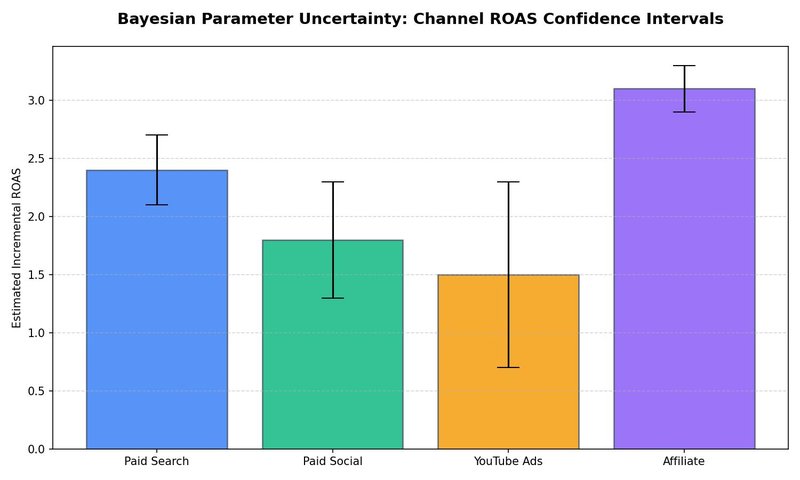
**Posterior ROAS distributions.** Rather than a single point estimate, Bayesian MMM produces a full probability distribution for each channel’s ROAS. This tells you not just the most likely value but the complete range of plausible values. A channel with a reported ROAS of 2.5x might have a true ROAS between 1.2x and 4.1x — the uncertainty matters for decisions about whether to increase or decrease that budget.
**ADVI optimization for speed.** OptiMix computes this via Automatic Differentiation Variational Inference, a fast deterministic algorithm that produces results in minutes rather than the hours or days that MCMC sampling requires. For ecommerce brands running monthly reporting cycles, this means measurement you can act on in the same cycle.
**Prior distributions encode existing knowledge.** If you have run A/B tests or prior campaigns that give you information about a channel’s typical ROAS range, you can encode that as a prior. Weakly informative priors prevent extreme claims when data is limited while still allowing the model to learn from new data.
DTC Attribution covers how this differs from traditional last-click attribution and why Bayesian MMM is specifically better suited to the DTC ecommerce customer journey.
## How to Calculate ROAS Across Multiple E-Commerce Channels
Calculating true ROAS across multiple channels requires modeling them jointly. The step-by-step process:
**Step 1: Collect weekly spend and revenue data**
Gather weekly spend for each channel — paid social (Meta, TikTok), paid search (Google), email platform costs, display/programmatic spend — alongside total weekly revenue from your Shopify, WooCommerce, or Magento store. A minimum of 26 weeks is required for reliable estimates.
**Step 2: Model baseline and channel contributions**
The model estimates baseline revenue (what you would have earned with zero marketing spend) separately from channel contributions. This matters for ecommerce brands: some revenue would have happened regardless because of brand loyalty, organic search, or referrals. MMM separates this organic baseline from the marginal revenue that marketing spend adds.
**Step 3: Account for saturation and carry-over**
Each channel’s contribution is modeled with a saturation curve (the point at which additional spend produces diminishing returns) and a carry-over effect (how campaign impact persists over subsequent weeks). For ecommerce brands running evergreen campaigns, carry-over is particularly important — the effects of a major campaign often persist for 3–6 weeks.
**Step 4: Review posterior distributions, not point estimates**
For each channel, OptiMix shows the full posterior ROAS distribution. Ask: what is the probability that this channel’s true ROAS exceeds 2x? What is the probability it is below 1x? This probabilistic view is what enables confident budget decisions — you are not betting on a single number but understanding the full range of plausible outcomes.
**Step 5: Use the allocator with movement caps**
Once you have posterior estimates, use OptiMix’s budget allocator to model how reallocation would affect projected revenue. Set movement caps (e.g., no channel moves more than 20% from current spend) so recommended changes are operationally feasible.
## E-Commerce Retail Media Networks vs. Paid Media Measurement
Many ecommerce retailers now operate or participate in retail media networks (RMNs) — selling ad inventory to brands that want to reach customers at the point of purchase. This creates a dual measurement challenge:
**As a media buyer:** You are spending on paid social, search, email, and display to drive product sales. Retail media measurement tells you how effectively each of these channels contributes to revenue.
**As a media seller:** If your ecommerce platform hosts a retail media network, you are also selling sponsored product placements and display ads to brands that want to reach your customers. Measuring the effectiveness of your own marketing spend on your RMN requires separating the buyer and seller perspectives.
MMM helps you measure the buyer perspective: how effective is your paid media spend in driving sales on your own platform, accounting for the halo effect of your RMN activity on organic and direct traffic.
Retail MMM covers the full channel coverage and how Bayesian MMM handles the omnichannel retailer specifically.
## E-Commerce Retail Media Measurement vs. Last-Click Attribution
The practical difference between Bayesian MMM measurement and last-click attribution comes down to what question each approach answers:
| | Last-Click Attribution | Bayesian MMM (OptiMix) |
|–|————————|———————-|
| **Question answered** | Which touchpoint closed the conversion? | How much did each channel contribute to total revenue? |
| **Time horizon** | 1–28 day lookback | 4–8 week modeling window |
| **Upper-funnel contribution** | Invisible (zero credit) | Captured via carry-over modeling |
| **Cross-channel interactions** | Invisible | Explicitly modeled |
| **ROAS output** | Point estimate per platform | Full posterior distribution per channel |
| **Speed** | Instant (platform dashboard) | ~15 minutes |
| **Data required** | Platform conversion data | 26 weeks of weekly spend + revenue |
For cross-channel budget allocation — where should your next $50K go? — MMM is the right tool. For within-channel tactical optimization — which ad creative in paid social is performing best? — platform-native analytics and MTA remain appropriate.
The two approaches are complementary: use MMM for the strategic “where to allocate budget” question, and use platform analytics for the tactical “how to optimize within a channel” question.
## FAQ
Frequently Asked Questions
Q: What is retail media measurement for e-commerce?
A: Retail media measurement for e-commerce is the process of quantifying how effectively each paid media channel contributes to online revenue — accounting for cross-channel interactions, delayed conversions, and diminishing returns. Unlike siloed platform reports that show only last-click conversions, Bayesian MMM (OptiMix) models all channels jointly and produces full posterior ROAS distributions, giving ecommerce brands a unified view of true channel effectiveness. DTC Attribution covers how this differs from traditional last-click attribution for direct-to-consumer brands.
Q: How do you measure retail media effectiveness?
A: Measure retail media effectiveness by modeling all channels jointly with Bayesian MMM rather than relying on individual platform conversion reports. OptiMix requires 26 weeks of weekly spend and revenue data across paid social, search, email, and display, then uses ADVI optimization to produce posterior ROAS distributions for each channel. This gives you not just a point estimate but the complete range of plausible values — so you know not just the most likely ROAS but how confident the model is. Nielsen research shows retailers using MMM-driven measurement consistently identify 15–30% of spend that underperforms against true incremental contribution.
Q: How do you calculate ROAS across multiple e-commerce channels?
A: Calculate cross-channel ROAS by collecting weekly spend and revenue data for each channel, then modeling them jointly in a Bayesian regression. The model separates baseline revenue from marginal channel contributions, accounts for saturation curves (where additional spend produces diminishing returns) and carry-over effects (how campaign impact persists over weeks), and outputs a posterior probability distribution for each channel’s ROAS. OptiMix automates this entire workflow in approximately 15 minutes, producing actionable channel-level ROAS estimates with transparent confidence intervals.
Q: What tools measure retail media performance?
A: Tools for measuring retail media performance range from platform-native conversion reports (free, siloed, last-click only) to marketing mix modeling platforms. OptiMix provides Bayesian MMM specifically designed for ecommerce brands with 2–5 channels and 26+ weeks of data, delivering unified channel-level ROAS estimates with uncertainty quantification in under 15 minutes. Enterprise alternatives like Nielsen, IRI, and proprietary statistical models exist but require six-figure budgets and dedicated data science teams. Meta Marketing Science also provides incrementality testing tools that complement MMM by providing ground-truth causal calibration data.
Q: How does Bayesian MMM differ from last-click attribution for e-commerce?
A: Bayesian MMM differs from last-click attribution in four critical ways: (1) It models all channels jointly rather than siloing platform reports; (2) It captures upper-funnel contributions via carry-over modeling rather than assigning them zero credit; (3) It produces full posterior probability distributions rather than single point estimates; (4) It answers the causal budget allocation question (“where should the next dollar go?”) rather than the tactical conversion question (“which touchpoint closed?”). For ecommerce brands making cross-channel budget decisions, Bayesian MMM is the appropriate tool. Harvard Business Review documents that last-click ROAS without cross-channel modeling systematically over-credits lower-funnel channels, leading to 15–30% marketing efficiency losses.
Q: Can small e-commerce brands use Bayesian retail media measurement?
A: Yes. The traditional barrier was cost and complexity — enterprise MMM tools required six-figure budgets, dedicated data science teams, and years of data. OptiMix specifically removes these barriers for ecommerce SMBs: 26-week minimum data (realistic for most established DTC brands), guided non-technical setup, results in under 15 minutes, and pricing at $499/month. A DTC brand with 2–5 channels and $20K+/month in marketing spend is an ideal candidate. The ROI of identifying even a 10–15% budget misallocation typically exceeds the annual cost of the tool within the first quarter. MMM ROI for Small Business covers the specific efficiency gains for smaller ecommerce operations.
Further Reading & Sources
- arXiv — open-access research papers and preprints
- Deloitte — professional services and consulting
- Harvard Business Review — business management research
- McKinsey & Company — global management consulting
- Statista — statistics and market data
Owner’s Note
The practical question is whether the metric still makes sense after margin, quality, and incrementality are included. Before changing the budget, compare the article’s framework with your own last 30 to 90 days of spend, revenue, and qualified outcomes. The best next move should be small enough to test, clear enough to measure, and tied to profit rather than platform-reported activity.
Leave a Reply